Gesnerium family. Homeland - moist mountain forests of Mexico and Guatemala. There are about 8 species in nature.
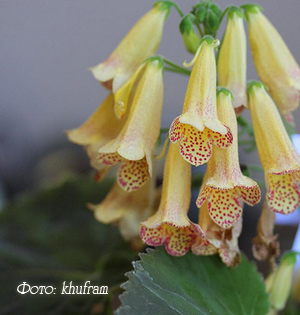
- The striped Smithiantha zebrina is a perennial herb about 50-60 cm tall. The stems are erect, the leaves are opposite, up to 17 cm long and heart-shaped, serrated along the edge. Leaves of beautiful emerald green color with a brown tint along the veins, pubescent. Large flowers about 5-7 cm long are collected in racemose inflorescences. The corolla of the flower has the shape of an elongated bell of bright orange color. It blooms from summer to late autumn.
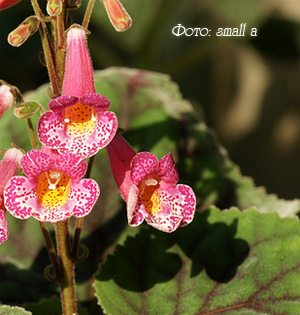
- As a houseplant, the Smithiant hybrid Smithiantha hybrida is common - there are many forms obtained from the previous species, differing mainly in the smaller size of the bush and the color of the flowers - yellow, orange, pink, etc., as well as a simpler and lighter leaf pattern.
Caring for Smithiana
Temperature: In summer around 20-25 ° C. Smithy has a dormant period, it comes with the end of flowering. Leaves, while the plant loses, the rhizome must be dried right in the pot and put in a cool room, where the temperature is about 15-16 ° C. Winter minimum 13 ° C.
Lighting: Smitianta is light-loving. Bright light is required, with shading from direct sunlight on sunny days in summer.
Watering: From spring to the end of flowering in autumn, the smithy is watered abundantly, then, when the leaves die off, watering is stopped and, with cool maintenance, the rhizome is left in the pot until new shoots appear in spring, then watering is resumed.
Fertilizers: Regularly from April to October, they are fed with a solution of mineral fertilizers for flowering indoor plants. Feeding is carried out once every two weeks. The dose of fertilizer is taken two times less than for ordinary indoor plants. During the rest period, no feeding can be carried out.
Air humidity: During the period of growth and flowering, the smithian needs very humid air, but does not tolerate water ingress on leaves and flowers. Therefore, the air is moistened by frequent spraying around the plant from a fine sprayer, or the plant pot is placed on a tray with wet pebbles or sphagnum moss.
Transplant: Smitiants use sufficiently wide pots for growing, not a large height. Transplanted annually in the spring. Soil - a mixture of sheet (2 part), turf (2 part), coniferous (1 part), peat (1 part), with the addition of coarse river sand, the pH reaction is slightly acidic. You can also use purchased mixtures of "Violet" and the like for senpoli.
Reproduction: Division of the rhizome. Rhizome should be divided in spring, with the end of the dormant period (in March). It is cut with a knife and planted in separate pots. Watered little by little, moderately, until the first leaves appear. When the green mass increases, you can increase the watering. When planting, rhizomes are deepened into the soil by no more than 3 cm and carefully watered until young leaves appear. And also the smithian is propagated by leaf cuttings, exactly like senpoli. A leaf with a petiole is rooted in water.
