Root family. Homeland - South and North America, Africa, Asia, Japan and Australia. There are more than two hundred species of deciduous or evergreen trees and shrubs in nature. At home, mainly in China and Japan, zantoxylum is used in cooking as a spice for seafood.
Zantoxylum is known by the names Japanese pepper, Sichuan pepper and hua-zhao (Chinese name).
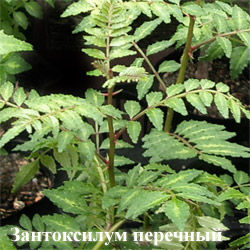


- 3anthoxylum peppermint Zanthoxylum piperitum is an evergreen shrub or tree, in nature up to 3 m in height. It has unpaired, sometimes ternate leaves, with opposite whole-crowned or serrated segments, of which there are always an odd number from 7 to 17. The leaves are light green, rather thin, elongated oval, pointed at the end with a town-shaped (rounded) edge. The bark of the trunk and shoots is smooth, gray. On the trunk there are spikes, like citrus. Racemose axillary inflorescences bear small yellow dioecious flowers (flowering May-June), appear only on old branches. The fruit is pink or reddish with a citrus smell (has two black seeds).
- Zantoxylum americanus Zanthoxylum americanum is the birthplace of the United States. Branching shrub up to 6 m in height. The bark of the trunks is brown, with sharp spines. The shoots are long, drooping. The leaves are pinnate, with opposite segments - leaflets, up to 11 in number. Each leaflet is dark green in color, spineless, oval in shape, pointed at the end. The leaves are dense, slightly bent along the central vein, with an even or serrated edge. The fruit is red about 5 mm in diameter.
- Zanthoxylum fagara is a branched evergreen tree, 4.5 to 7.5 m high, common in Florida coastal forests (in the Bahamas, Mexico, etc.). The trunk is prickly (spikes bent), with gray bark, the branches are thin, the leaves are complex pinnate, dense. The number of leaflets is always odd, each about 4 cm long, obovate in shape with a town (rounded toothed) edge, with a very short petiole. Flowering in the homeland occurs throughout the growing season. The flowers are small, yellow, collected in multi-flowered axillary inflorescences. The fruits are fleshy, about 1 cm in diameter, with large black seeds.
It is the Zantoxylum of the phagar that is often confused with the Operculicaria. The main difference is the presence of sharp numerous spikes in Zanthoxylum fagara and the absence of waxy glossy shine on the leaves. The zantoxylum fruit is not at all like an orange or lemon berry - it is a small box. But if you crush-rub it with your fingers, you will feel a clear citrus aroma.
Zantoxylum - care and maintenance
Temperature: Zantoxylum in nature grows in subtropical areas, quite thermophilic. In winter, it is optimal 16-18 ° C, at least 12 ° C (planted in small pots and bonsai does not tolerate frosts and drafts!). In summer, zantoxylum is located outdoors under light shade. The ideal option in summer is the east, northwest window, even the southeast; in winter, maintenance on a sunny windowsill without shading is permissible.
Lighting: Bright diffused light in summer, with some direct sun (shading is only necessary in the afternoon). In autumn and winter - full sun.
Watering: Plentiful from spring to autumn, watered much less often in winter, but do not allow the soil to dry out. From excessive dampness, the roots can rot, with insufficient watering, the leaves fly around, if the plant is dry, it can die. He does not like zantoxylum watering with hard water, despite the fact that he has spikes and the need for calcium is quite high.
Fertilizer: From April to September, they are fed with complex fertilizer for indoor plants. Feeding is carried out weekly, in half a dose.
Humidity: Zantoxylum requires very high humidity, so it is regularly sprayed. Tolerates weekly hot showers well (as a spider mite prophylaxis).
Transplant: Transplantation in spring young annually, more mature - once every 2-3 years. Soil mixture: 2 part of sod, 1 part of leaf earth, 1 part of humus, 1 part of sand (fine expanded clay, vermiculite). Or a purchased soil mixture for citrus fruits and baking powder (expanded clay, vermiculite, small gravel).
Reproduction: Cuttings and branches in early spring, seeds.
In almost all countries where zantoxylum grows, it has found medical use. So, the Indians treated them literally everything - from fever, cough, to rheumatism, burns and wound surfaces. In the modern world, zantoxylum extract has been introduced into medicinal shampoos, toothpastes, cuperosis cream and medicines.
All parts of the plant: bark, leaves, zantoxylum berries have a tonic, wound healing and antibacterial effect. If you suffer from periodontal disease, caries or bleeding gums, then look for toothpaste containing zantoxylum extract.
