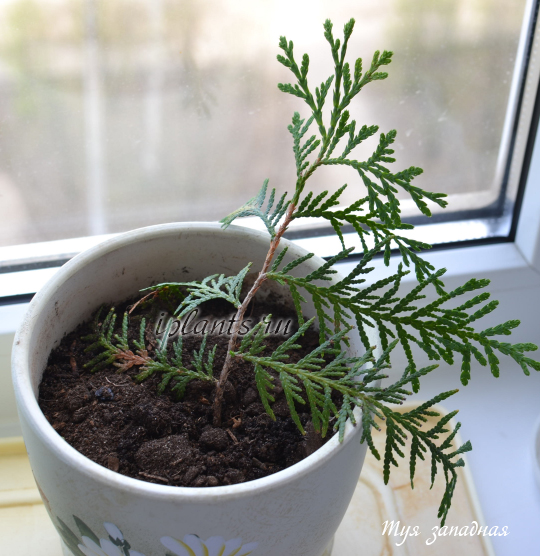
Cypress family. Homeland North America.
Western Thuja occidentalis is an evergreen coniferous plant with a pyramidal crown, lives in good conditions for a very long time, reaching an average of 10-15 m in height with a trunk thickness of about 40 cm. The bark of young plants is smooth, reddish-brown, furrowed with age, stratified by stripes. The needles are scaly, dense, small (scales about 3-4 mm), saturated green, acquires a brown color by winter. Every 2-3 years, the thuja renews the foliage, throwing in twigs and overgrown with new needles . Thuja has small 10-15 mm egg-shaped cones with delicate scales, similar to dried buds. There are over 300 varieties of tui.
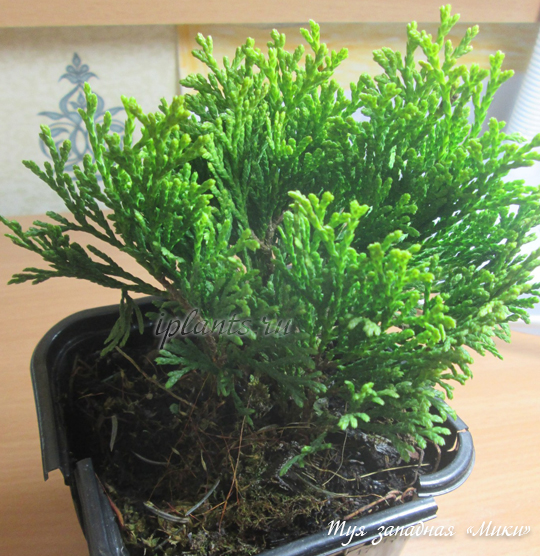
The original species - western thuja - is a garden plant, but is sometimes grown as a pre-bonsai. However, there are various varieties of western Polish-bred thuja on sale. Among them are compact plants that grow perfectly in pots. For example, the miniature variety of Miki Thuja occidentalis' Miky '- has a fine foliage structure that remains a rich green color throughout the vegetation. The crown is very dense, dense, in an adult plant of a wide conical shape. In winter it can take on a copper hue. The shoots are slightly twisted, giving the variety an extra charm. Thuja grows rather slowly: in 8-10 years it will grow about 70-80 cm high and about 50 cm in girth. This variety practically does not need to cut shoots.
Tuya landing and care
At home, thuja - a wonderful decoration of a balcony or terrace - loves fresh air, does not tolerate content in the kitchen or in a smoked room. It also looks attractive in the garden: in the mountainarium, rocky gardens, it is perfectly combined with other conifers.
Temperature
The frost resistance of the plant is zone 5b if you plan to grow thuja in a greenhouse or garden. At home in the summer we have the temperature that is dictated by the weather, but cypress trees do not tolerate heat - for optimal growth they need 22-24 ° C. In winter, a cool content is mandatory, + 8-10 ° С is enough, at least + 2 ° С. At the same time, the soil in the pot is almost completely dry. At the lower temperature limit, the plant must be insulated. You can put the pot in a box with sawdust, wrap it in foam rubber, put it in a large pot and fill dry earth between the walls. Coolness must be ensured with the onset of the heating season and until the beginning of February.
Lighting
Thuja is photophilous, prefers some sunlight, better before lunch - the east or southeast side, or in the evening - the northwest. In the period from February to May, from 12 to 15 hours, openwork shading is desirable - at this time the most active sun can cause burns (browning of needles). By summer, thuja is well accustomed to the sun and does not need shading if it has enough fresh air.
- Attention: at temperatures above 26-27 ° C, the direct sun of thuja is difficult to tolerate. Therefore, if the pot stands on an open balcony or by an open window (not micro-airing, but a well-open window), shading is not required. If you are closing windows, it is better to rearrange the pot on a shady, but not hot windowsill. Young plants especially need shading. In nature, thuja seedlings (from self-seeding) have been growing in the shade of taller trees for decades.
You may have heard that thuja shade - this statement applies only to garden conifers, at home lighting is always one-sided, and growing on the north side can lead to the formation of uneven crown. So if you have the north side, gradually turn the pot on the window.
Watering
During the growth period, especially in hot weather, watering is quite plentiful, with drying of the upper layer of the earth. Do not leave water in the tray after watering. Thuja does not tolerate drying out - as soon as the soil dries, it deplorably lowers the branches, but after moistening it immediately restores the turgor. If it is too dry, especially in the heat, it is irreversible. When the rainy season and a sharp cold snap begin in autumn, make sure that the watering is infrequent and the soil has time to dry out almost completely in 3 days.
- Important: the correctness of irrigation is regulated not only by its frequency and volume of water, but also by the composition and structure of the soil.
- For reference: in nature, thuja grows in moist forests, especially abundantly on coniferous swamps, but at the same time the root surface, not completely immersed in water, but on a well-drained substrate. But the most famous long-lived thuys, aged up to 1000 years, have survived on cliffs and rocky terrain. For thuja, air humidity is more important than soil humidity - avoid both waterlogging and drying.
Fertilizer: Tuye dressing is required two months after transplantation if the soil is too poor. You can purchase special fertilizer for conifers or use universal non-alkaline and chlorine-free for ordinary indoor plants.
Air humidity: Tuya loves very humid air, optimally 60-80%, humidity below 40% requires moisture - spraying 2-3 times a day or placing a pot on a wide tray of water (water should not come into contact with the roots). With the start of the heating season, transfer the plant to a cool room.
- If there is no possibility of cool wintering, you have two options: fence off the edge of the windowsill from the battery with plexiglass or greenhouse film, put in a humidifier and add artificial lighting. Or, if the size of the bush exceeds the size of the windowsill, do not torment the plant - grow it in the garden.
Tui transplant
Potted thuja is transplanted annually or once every two years, very carefully, preserving the root lump as carefully as possible. When planting, it is important not to tamper too tightly with the soil and not to bury the root neck (the soil level is at the same level, without swelling). Healthy roots are brick brown, elastic in appearance. Soil: 1 part of clay-turf land, 1 part of sheet (or peat), 1 part of baking powder (zeolite granules or acadama, you can vermiculite or agroperlite, coarse river sand - sifted up to 2-4 mm). The pot should not be too big - a little larger than the root system. At the bottom, make many holes for water drainage, drainage optional (in a high pot is mandatory). If the soil is closer to neutral in acidity, add a couple of spoons of pine needles or bark to the pot.
Thuja grows well on slightly acidic soils, does not tolerate latching and strongly acidic soil - optimally pH 5.5-6.5. If the substrate has caked and compacted, you need to carefully loosen it to a depth of 5-6 cm. If a salt deposit appears on the surface of the soil, you need to remove it and water the plant with softer water (filter, boil, soften with aquarium water products).
If you use peat-based store soil, keep in mind that it consumes nutrients quickly, and in its pure form is far from ideal for thuja (dries quickly), but can serve as one of the components. In addition, store soils are often filled with a large dose of fertilizer, even specialized coniferous mixtures tend to be based on pure peat and sand, while light loam will be the ideal soil base for thuja. But do not forget that growing in a closed system (limited by the walls of the pot) deprives the roots of an important element - oxygen. With excessive watering, the roots will suffocate if the soil is not porous enough (clean loam). That is why we add baking powder. Drained soil does not mean drainage at the bottom, but drainage particles in the soil itself between the roots.
Forum theme: Bonsai from tui - options for forming tui, as well as the theme of Conifers
Tui reproduction
Tuya is propagated by seeds and cuttings. Seed cultivation is impractical - the representative of cypress grows very slowly. But it's a pleasure to grow cuttings - it's important to know how! Very simple: in autumn or spring, cut a twig of thuja about 15 cm long.
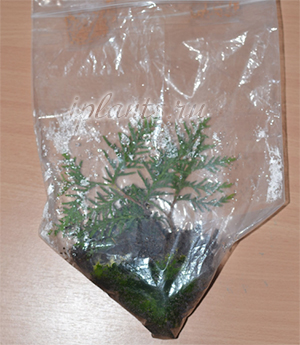 Fill the zip bag with sterilized soil, stick the handle and close
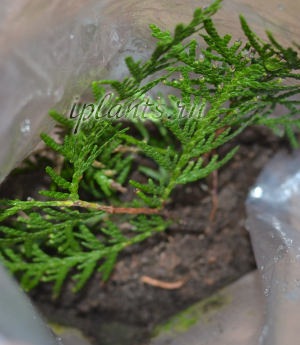 If blue-green algae appear on the walls, it's okay, it's from high humidity
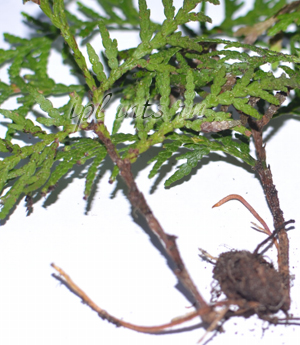 You can put thuja cuttings in a pot when they grow 5-7 cm
Take a spacious zip bag (on the clasp), prepare the soil: 1 part of the universal soil (for example, Terra Vita living earth) and 1 part of the sand or vermiculite. Stir and sterilize for 3 minutes in the microwave. Cool and pack. The substrate should be moist, but not too raw (moisten with boiled water). Place the handle in the substrate and close the bag tightly. Hang it in a bright place - if the stalk is cut in the fall (in October-November), then you can hang it on the south window without shading. If in early spring, then only under the shade from the direct sun. There is no need to open the bag, it retains about 90% humidity. Just wait for the roots to appear. They are dark, not light, as in many houseplants, so they are not noticeable.
When thuja takes root, it must be transplanted into a pot in the soil described above for adult plants. Put the pot in a bag and tie. Shade the first week from any sun and ventilate 2-3 times a day. After a week, the package can be untied, but not removed, but gradually accustomed the young plant to drier air. As soon as the opportunity arises, put the pot in the fresh air on the balcony.
Forum topic: Tui reproduction you can discuss, add your comments and share experiences.