Kutrov family. Homeland tropical and subtropical areas of America and Africa (Zimbabwe and Mozambique), Fr. Madagascar. The genus includes about 25 species, distributed for the most part in the coastal zone.
These are mainly shrubs or small trees, about 4-6 m tall (although specimens are found up to 15 m tall) easily flowering throughout the year, and Tabernemontana fruits are quite edible, although monkeys and birds feed on them.
It is known that the bark of Tabernemontana (gray-brown, in some species very cracked) is used as a folk remedy against fever (to bring down the temperature), and juice as a remedy for wounds.
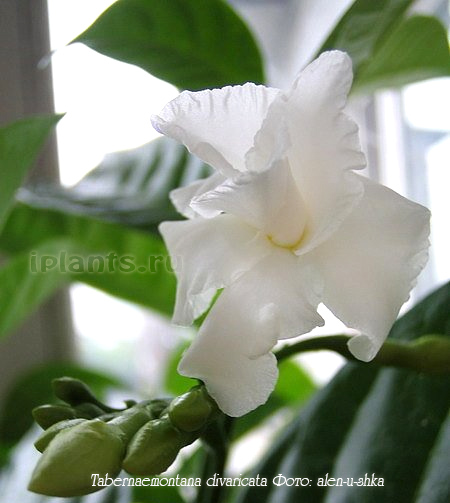

- Tabernemontana spread Tabernaemontana divaricata is an evergreen, well-branched shrub-like or tree-like plant, has large glossy, dark green, oppositely arranged leaves about 15-20 cm long, oblong in shape, pointed at the end. On the back of the sheet, transverse veins clearly protrude. Branches on the bush are located almost horizontally. The flowers are white, the corolla is five-lobed, the petals of the flower are slightly curved in a spiral, simple or double. The aroma of flowers is very persistent, resembles the smell of jasmine, especially the aroma is enhanced at night. In general, the plant resembles jasmine in appearance, so they are often confused. In fact, these two plants have nothing in common, but the main difference is quite simple - and milky juice is released in the leaf or stem of Tabernemontana, which does not happen in jasmine. The fruit is pod-like, more precisely, like two pot-bellied fused pods, dark green above, almost brownish in color, smooth or wrinkled, sometimes in a light speck, and the flesh is orange and juicy.
- Tabernemontana elegance Tabernaemontana elegans - a somewhat smaller species - in nature about 3-5 m tall. It is less fragrant, but more unpretentious. Unlike Tabernaemontana divaricata, it is more resistant to direct sunlight and frost.
Tabernemontana care
The main maintenance consists in maintaining the soil in a uniformly moistened state, without overdrying or waterlogging, periodic loosening of the upper layer of the soil, as well as pinching and pruning elongated shoots to give the desired shape and improve branching.
Temperature: Like all heat-loving Tabernemontan coasters, in summer the usual room temperature, in winter not lower than 15 ° С, is optimal 18-20 ° С. In summer, the plant can be taken to an open balcony or garden when the threat of night cold snaps passes. A draught-proof space is required.
Lighting: The plant needs a very bright place, with some direct sun in the morning or at the end of the day. Shading is necessary only at noon in the summer. A bright east window is perfect, or the window sill of the west window, if it is slightly shaded from the street by trees. The south or light west window can be too hot on hot days in summer.
Watering: Tabernemontana is sensitive to waterlogging, watering in the summer is moderate: after the earth dries in the upper part of the pot, water in 2-3 days (in hot weather in 1-2 days). In winter, watering is even more strict - after making sure the ground is really dry in the back of the pot, wait a few more days. It is very important to select the soil so that it does not stick together into a monolithic mass, but is easily wetted and quickly dries. It is not bad for improving the structure of the soil and better aeration of the roots to add coconut chips (from briquettes) to the soil. If suddenly it gets colder outside in summer, the soil in the pots can dry for a very long time and tabernemontana risks the health of the roots, so loosen the soil in the pot at a depth of 5-6 cm.
Fertilizer: March to August every two weeks with fertilizer for flowering indoor plants, such as Rainbow or Fertica Suite. Try not to exceed the dose of fertilizers, this will lead to malnutrition, instead of abundant flowering, yellowing of leaves and oppression of the entire plant will begin. Tabernemontana is very sensitive to iron and potassium deficiencies.
Air humidity: Requires quite high air humidity, responds well to spraying. There is a small rule - it is better to spray once again than water!
Transplant: Spring annually. The soil should be loose and pass water well. As you know, Tabernemontana is quite patient with the acidity of the soil, in nature it grows on both slightly alkaline and slightly acidic soils, on loam and sand. In room conditions, the following mixture is suitable: 1 part of peat, 1 part of sheet earth, 1 part of humus, 1 part of sand, 1 part of perlite (or vermiculite). Drainage is mandatory. You can use purchased peat-based land with a pH close to neutral or slightly acidic reaction, and be sure to dilute it with vermiculite and sand, you can also use fine expanded clay (about 2-3 mm). Do not use dense clay soil that sticks together after watering into a solid monolithic lump.
Reproduction: Cuttings and seeds that germinate during soil heating in wide areas covered with glass or a bag. The depth of the seeds is approximately 10 mm. Soil for seeds - peat in half with sand, sterilization is required. Usual care: spraying, watering with boiled water and airing 2-3 times a day.