Eriocaulon family. Homeland - Brazil, Japan, Africa. About 80 species are common in nature. Many species in their homeland are rare, endangered plants.
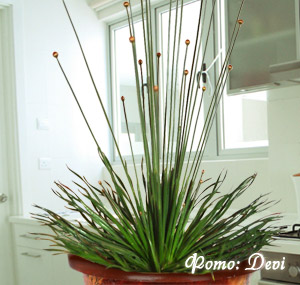
- Syngonanthus chrysanthus is a perennial plant with delicate thin green leaves, lanceolate, about 10-15 cm long, collected in a rosette, on a very short stem. Peduncles are long, light green, about 35 cm long, with gentle pubescence, there are from 20 to 50 pieces per rosette. The inflorescence is a miniature basket, about 1 cm in diameter, with golden flowers. Flowers have no aroma, stay on the plant for about one to one and a half months. The flower is beautiful during the flowering period due to the numerous flower arrows. The variety 'Mikado' is found on sale.
Care of Singonanthus
Temperature: The plant is thermophilic. In summer it prefers 22-26 ° С, in winter it is optimal 16-22 ° С, but not lower than 10 ° С. Singonanthus does not like cold drafts and sharp temperature fluctuations after copious watering.
Lighting: Bright diffused light, you need shading from direct sunlight in spring and summer, but does not even like light partial shade - the place should be very light. In autumn and winter, artificial illumination or a sunny southern window may be needed.
Watering: Plentiful in summer, the ground should not dry out completely, but dry well at the top of the ground. In winter, watering is moderate, at least 5 cm deep, the ground should be dry. For watering, only soft filtered and boiled water is used, watering from a tray is possible. With top watering, you need to water with watering can, and make sure that water does not fall into the rosette of leaves.
Fertilizer: From May to September, every 2-3 weeks, fed with azaleas fertilizer diluted twice the recommended dose. The plant is sensitive to an overabundance of fertilizers, very sensitive to a lack of iron.
Air humidity: The birthplace of this plant is a swampy area in the tropics of America, so it is preferable that the humidity is about 70-75%. In this regard, syngonanthus is grown in wide glass glasses, large volume or round aquariums. At the same time, spraying for the plant is not desirable, because can cause fungal diseases and spots on the leaves, especially if the water is not soft enough.
Transplantation: This amazing plant is rarely transplanted, because it is very difficult to tolerate root injuries. The soil mixture should have an acid reaction, pH 4-5, be light and breathable. Therefore, leaf earth or peat is used, with the addition of pieces of bark or chopped roots of ferns and small gravel. Store soil for heather (rhododendrons and azaleas) is suitable. Despite being a genus of Singonanthus from the marshy regions of Brazil, when grown in pots, it needs high drainage. The pot should be chosen with a diameter of 10-12 cm and about 15 cm in height.
Reproduction: Seeds. At home, it is almost impossible, European and western greenhouses selling flowers grow Singonanthus from seeds in a test tube using the same technology as orchids.
