Acanthus family. Homeland tropical and subtropical areas of America. More than 160 species of ruellia grow in nature, many of them do not have an official status (scientists doubt whether they are attributed to a separate species, or these are clones of existing species). It is a rapidly growing houseplant that can be grown in hanging baskets or planters.
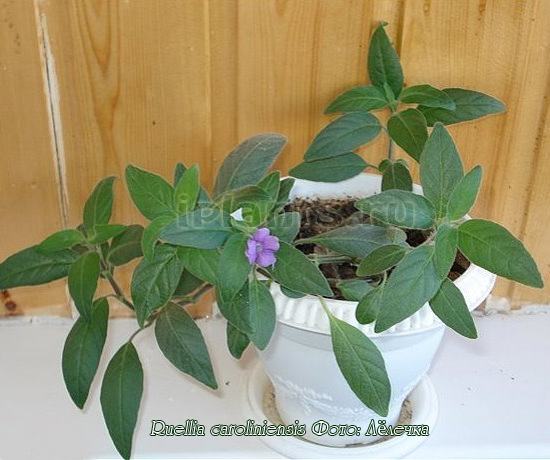
Ruellia caroliniana
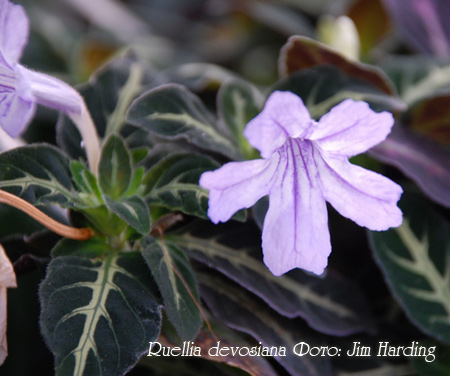
Ruellia Devo
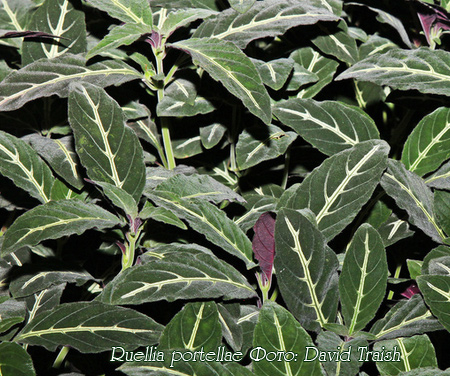
Ruellia Portella
- Ruellia Devo Ruellia devosiana is a herbaceous perennial plant about 40 cm tall. Stem with grayish pubescence, leaves up to 7 cm long, elliptical, velvety, dark green on the upper side, light along the veins, purple on the underside. Flowers up to 2 cm in diameter, single, axillary. Corolla limb pale lilac or white.
- Ruellia portella Ruellia portellae is a herbaceous perennial plant about 50-60 cm tall. Stem with grayish pubescence, leaves up to 8 cm long, oblong, velvety, dark green on the upper side, light along the veins, purple on the underside. Flowers up to 2.5 cm in diameter, single, axillary. The corolla limb is bright pink.
- Carolina ruellia Ruellia caroliniensis is a herbaceous perennial plant with semi-ampellated stems up to 50 cm long. The stems and leaves are covered with dense pubescence. The leaves are simple, green, with pronounced venation. The flowers are bell-shaped, lilac, 2-2.5 cm in diameter .
- Tuber ruellia "Ruellia tuberosa" is a small biennial plant with a thick spindle-shaped rhizome. Forms bright funnel-shaped, violet-colored flowers. It grows in nature as a weed, is often used in folk medicine, as a diuretic, antidiabetic, antipyretic, anesthetic, antihypertensive, gastroprotective agent.
Ruellia - care and cultivation
Temperature: In summer, optimally about 22-24 ° C. Ruellia does not like a higher temperature, the leaves dry out, and the stems are exposed from below, one might say that the plant burns out from the heat, although it can bloom. In winter, the optimal 18-20 ° C, the minimum 14 ° C. Protect the plant from the heat of batteries.
Lighting: Ruellia is photophilous, but in spring and summer it requires shading from the midday sun. In spring and summer, it grows best on the eastern windowsill. In order for the flowering to last longer, additional lighting is arranged in the fall so that the daylight hours are at least eight to nine hours.
Watering: Plentiful in summer, the soil should be slightly moist inside the pot all the time, but dry on top. Watering is very moderate in winter, but since the plants are kept warm, the soil should not dry out completely.
Fertilizer: From April to August, ruellia is fed with liquid fertilizer for indoor ornamental flowering plants every two weeks. Do not be zealous with organic fertilizers - this reduces the productivity of flowering.
Air humidity: Ruellia needs high air humidity, if the humidity is below 40%, the pot must be put on a tray with wet gravel. If in summer the temperature stays above 25 ° C for a long time, there is no rain - this is also a reason to increase humidity, for example, using a humidifier. Remember that dry air cannot be replaced with more frequent irrigation, otherwise the roots of the ruellia will begin to rot.
Transplantation: In spring, ruella is transplanted into loose, light soil, consisting of 1 part of turf, 1 part of leaf, 1/2 part of peat, 1/2 small gravel. You can take a universal soil, for example, Terra Vita, add a handful of vermiculite or perlite to it (per 1 pot), add liquid or loose biohumus.
Reproduction: Cuttings and seeds. Cuttings are easily rooted in water in spring or summer. Seeds are sown in wide plates in a mixture of sand and peat, moistened from a spray bottle and put in a greenhouse (not forgetting to ventilate), the temperature is about 20-25 ° C. When the seedlings grow up, they are planted 5-7 pieces in one pot. This allows you to get more lush and decorative bushes.