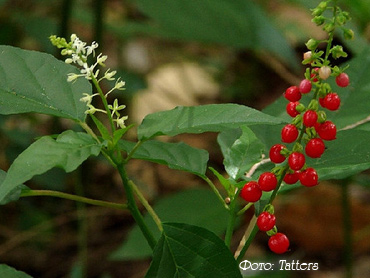
Laconose family. Homeland Central and South America (Southern states of the USA, Chile, Argentina).
Rivina low Rivina humilis is a herbaceous plant or shrub, about 1.5 m tall, with lignified stems. The leaves are alternate, oblong, pointed at the end, slightly wavy, up to 12 cm long, green, pubescent. Inflorescences are axillary racemose, about 10 cm long. The flowers are pinkish-white, about 0.5 cm in diameter, the fruits are bright red berries, similar to clusters of red currants.
In order for the plant to have a more decorative lush appearance, it is regularly pinched or pruned. This can only be done in early spring (February-March), as it bears fruit on young shoots.
Care for rivina
Temperature: Moderate, cool in winter within 18-20 ° С, minimum 12 ° С. In a too hot room in winter and with a lack of lighting, there may be a loss of lower leaves.
Lighting: Bright diffused light with some direct sunlight, an eastern, western window and even a southern one will do, but with sun protection from 11 to 15 hours.
Watering: Plentiful from spring to autumn. The top layer of soil (in the upper third of the pot) should have time to dry before the next irrigation. In winter, watering is more limited, after the soil has dried in the upper layer, wait another 2-3 days before watering.
Fertilizer: From March to August, they are fed every two weeks with liquid fertilizer for indoor plants. Fertilizers are suitable for ferthica-lux, uniflor bud, etc.
Air humidity: Regularly sprayed from a fine spray bottle. Rivina loves moist air, so in winter it must be protected from the dry hot air of the batteries. Due to the requirements for humidity and cool temperatures in winter, rivina is more suitable for growing in greenhouses than apartments.
Transplant: Annually in the spring. Rivina is not demanding on acidity, but prefers loose leaf soils than dense clay ones, does not like too voluminous deep pots. The soil 2 part of the sod, 1 part of the humus, 1 part of the sheet earth and 1 part of the sand. Good drainage to the bottom of the pot must be done.
Breeding: Stem cuttings and seeds in spring. It is better to root cuttings in a mixture of vermiculite and peat, covered with a cap or bag to maintain high humidity. The rooted handle must be ventilated 2-3 times a day, shake off the condensate from the bag to avoid decay. The seeds are also sown in a mixture of vermiculite and peat, or in leaf earth. It is better to grow seedlings in a room greenhouse, which can be made from a cake box. Germinate seeds at a temperature of 24-25 ° C. When 2 pairs of real leaves grow, rivina seedlings can be planted in pots with a diameter of 8-10 cm.