Cactus family. Homeland - Brazil, Paraguay, Bolivia and Argentina. The genus name is derived from the Greek "cactus from the south." Now most species of this genus are united in the genus Parodia parody. Since the name Parodia was used before Notocactus, it took precedence and almost all Notocactus became Parodies.
Taxonomy with cacti and notocactus, in particular, is very dull. Either they were singled out as a separate genus, then they were ranked as parodies, but according to the latest data from The Plant List (The current list of all known plant species, compiled in collaboration with the largest botanical gardens in the world (Royal Botanic Gardens, Kew and Missouri Botanical Garden), the genus Notocactus is an independent genus, but only the only one is officially accepted species Notocactus horstii (F. Ritter) K. Herm
Notocactus horstii horsti Notocactus horstii is a spherical, slightly flattened cactus, at a young age with a height of about 10 cm, a diameter of almost 15 cm, an almost spherical trunk is gradually extended. The flowers are orange, yellow, pink, about 3.5 cm in diameter. The central spine is from 1 to 6, yellow-brown, straight, even or slightly curved, from 8 to 30 mm long. Radial spines 10-15 linear whitish or light brown, 6-30 mm long in different forms. The flowers are yellow-orange, reddish or purple, 3-4 cm in diameter.
 Notocactus horstii
 the unresolved name Notocactus uebelmannianus is possible, it is a synonym of Ritterocactus uebelmannianus
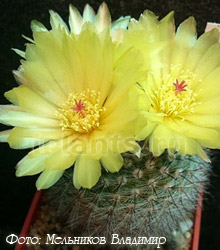 unresolved name Notocactus scopa is possible, it is synonymous with Echinocactus scopa
Care for Notocactus
Temperature: Normal in summer, it is better to keep cacti outdoors in a rain-protected place, for example, under a transparent canopy (transparent umbrella). The difference in night and day temperatures is beneficial. In winter, the rest period is at a temperature of 7-10 ° C, at least 5 ° C, with dry content (experimental growers can leave under control up to + 1 + 2 ° C).
Lighting: Bright lighting. Notocactus love a lot of light, but it is necessary to accustom to the spring sun gradually to avoid burns, especially if the wintering was cold and dark.
Watering: Abundant in cactus understanding in spring and summer, at temperatures above 22-24 ° C, i.e. after complete drying of the soil the next day or every other day. Since autumn, watering has been reduced, with a cold snap, when the temperature is below 20 ° C watering less and less, after the soil dries, you need to wait 5-7 days. Colder - even less often, preventing only strong wrinkling of the cactus stem (about once a month).
Fertilizer: From March to July, they are fed with special fertilizer for cacti once a month. Do not use conventional fertilizers for indoor flowers, they may contain too much nitrogen, even when diluted.
Air humidity: Notocactus are resistant to dry air, do not need spraying.
Transplantation: Soil - the 1 part of sheet earth (or universal peat soil, for example Terra Vita living earth), the 1 part of sand or small gravel (2-3 mm). Young plants are transplanted annually or a year later, old ones - as needed. The substrate should have a slightly acidic reaction. Pots are chosen shallow but wide. The spines of most notocactus are long, so place the pots so that the plants do not injure each other. It is advisable to make upper drainage so that the lower part of the cactus stem does not come into contact with the soil wet after irrigation.
Reproduction: Seeds and children. Seeds are sown in a moist sterile soil (a mixture of peat and coarse sand), germination at a temperature of 24-26 ° C. Mandatory airing of seedlings, moistening as it dries. As soon as seedlings appear, the best possible lighting.
Read more about the features of various maintenance modes, transplantation and reproduction in the section Cacti.