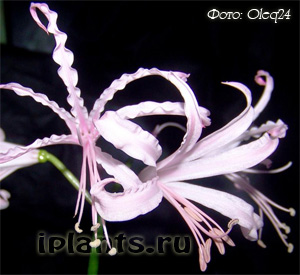
Amaryllis family. Homeland - South Africa. There are 25 species in nature.
Nerine Bowdenii, a perennial bulbous plant, is grown as a houseplant or greenhouse plant. The bulb is elongated bottle-shaped, about 5 cm long, the outer scales are shiny, light brown. The leaves are belt-shaped about 30 cm long, 2.5-3 cm wide, the sheaths of the leaf are closed, form a short false stem. The inflorescence is umbrella-shaped, on a leafless peduncle 45 cm long, at the base of the inflorescence is a flowering leaf, which over time acquires a reddish tint. Flowers from 6 to 12, with pink perianths. Bowden's nerin bloom occurs in the fall - October - November, with the end of vegetation, when the leaves practically dry.
Nerine - care and cultivation
Content and temperature: Bowden's Nerine actually has two resting periods. After flowering from the end of December-January, it does not grow and can be safely stored in the basement or on a heated but cool balcony at a temperature of 5 to 10 ° C, while with the end of flowering, the flower arrow is cut off. Occasionally, the soil can be moistened from a spray bottle. Try to observe the temperature regime, preventing the leaves from growing prematurely, otherwise the entire development cycle is disrupted, bows form children, but flowering may not occur in the future.
Care begins in April - the bulbs are brought into the room and transplanted into fresh soil. The growing season begins - the growth of new leaves. In May, when the threat of spring frosts passes (after about the 10th), the nerin can be taken out into the garden, or onto the balcony, in a place shaded from the heat. Since mid-July, watering is sharply reduced, in August they do not water at all - summer rest comes. In this case, the leaves of the nerin completely dry out. Sometimes the leaves dry out only partially, which may indicate a violation of agricultural technology (for example, if watering is not stopped completely).
Never prune green leaves from nerin (and other bulbous ones) - this weakens the bulbs, only dried leaves can be removed.
Lighting: Bright diffused light. In autumn, you also need good lighting for laying flower buds, so there is often a need for additional lighting.
Watering: During the period of leaf growth, watering is moderate (the soil should have time to dry out after the next watering), with the death of the leaves, a period of rest begins, during which watering is stopped.
Air humidity: The plant is not demanding on high air humidity, does not need spraying.
Transplant: In the spring - in April. Professionals advise not to transplant nerina too often - usually they are planted in spacious pots, and transplanted after 4-5 years. High drainage is poured onto the bottom of the pot, several bulbs are planted in one pot. Soil: 1 part of turf, 1 part of humus, 1 part of coarse sifted sand. The soil should be loose, not heavy, slightly acidic. When planting, the bulbs are buried in the ground, leaving only the upper third of the bow above the ground.
Personal experience in caring for nerin, Devi: When buying plants in a store, I came across the fact that instead of nerin they sell another flower of the amaryllis family - hymenocallis (their leaves are very similar).
I noticed that nerina is more willing to bloom in a cramped pot, and in a spacious one it drives children. But it needs very nutritious soil, so I add half of the well-rotted compost to the garden land. I must sterilize the earth in the oven and add the drug "trichodermin" when planting, because nerine bulbs are susceptible to rot.
Reproduction: Daughter bulbs during transplantation and seeds. Separated children are planted in the prepared soil mixture in separate pots with a diameter of about 12 cm so that a third of the height of the bulb remains above the surface of the earth. Plants grown from seeds bloom only in the third to fifth year.
