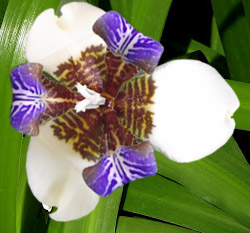
Iris family. Homeland - Tropical South America (Brazil, Mexico, Argentina, Bolivia, Paraguay). There are about 20 species in nature.
- Neomarica gracilis Neomarica slender - grassy, rather large plant . The leaves grow in a fan, xiphoid shape, glossy, green, 40 to 60 cm long, 4-5 cm wide, flowers 6-10 cm in diameter. Up to 10 flowers can form on each peduncle, one after the other. The flower begins to open in the morning, fully opens in the afternoon, fades in the evening. All parts of the plant are poisonous when ingested.
- Neomarica northiana Neomarica north - leaves 60-90 cm long, 5 cm wide, flowers very fragrant, about 10 cm in diameter, blue-violet with white, or lavender. It grows on acidic, slightly acidic and neutral soils (pH 5.6 to 7.5).
Neomarica - Care and Cultivation
Temperature
In summer, the usual room, preferably regular ventilation, fresh air access. In winter, neo-marika requires a decrease in temperature to 8-10 ° C, with extremely rare irrigation, this contributes to better flowering. If you have the opportunity to withstand a period of rest in the winter in the cool, then otherwise care is not difficult. But during wintering, it is important to wrap the pots in heat, for example, wrap them in a woolen scarf or put them in a box and fill them with sand around.
Lighting
Bright diffused light, with some direct sun in the morning or evening. In winter, it will grow well on the southern and western windows. And in summer, shading is required from about 12 to 15 hours, that is, at the hottest time.
Watering and humidity
Plentiful in summer, provided that the soil has time to dry out at the top of the pot. With a decrease in temperature in autumn and winter, watering is reduced, the soil should have time to dry well for the next watering almost to the entire depth of the pot. Air humidity is optimal in the range of 50-60%. Neomarika needs spraying on hot days in summer and in the dry heating season, periodically carry the plant into the shower to wash off the dust with warm water. After the shower, wait until all the water is glass from the drainage holes.
Fertilizers
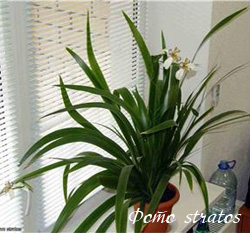
You can feed neomarika during May-June, every 2 weeks in a half dose of fertilizers. In nature, neomarica grows in the rainforest, often on a layer of fallen and rotting leaves and branches, on a substrate poor in the main nutrients of NPK. Therefore, if this plant is fertilized with organic matter or fertilizers for ornamental and deciduous plants, with a high concentration of nitrogen, then it will hurt and will not bloom. Neomaric fertilizers are well suited for orchids, and fertilizers balanced in NPK in equal quantities, for example 15-15-15.
Flight connections
Young plants are transplanted annually, large bushes in 2-3 years. Soil: 1 part of sod, 2 part of leaf or peat land, 1 part of chopped pine bark. Most neomarica species grow well on weakly acidic soils with a pH of 5-6, but the slender neomarica species is an exception, it grows mainly on neutral soils with a pH of 6.6 to 7.5. Therefore, the advice to plant it in the soil for conifers or azaleas is not entirely correct, if you buy soil, then take a universal soil. Neomarica has a creeping root system (rhizomes) and also forms a wide fan of leaves, so the pot for it should be stable with a wide bottom, but not too deep. Be sure to pour drainage on the bottom of the pot.
Reproduction
Neomarica is propagated by leaf rosettes formed on the peduncle after flowering, dividing the bush, seeds. Seeds very quickly lose germination, and you only need to plant fresh in a mixture of universal peat soil and sand in equal parts. Germination at about 25 ° C.
