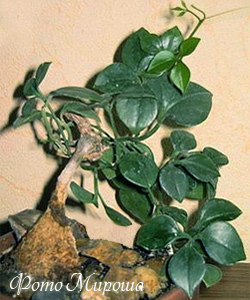
Pumpkin family. Homeland China, Malaysia, India. There are about 30 species in nature.
Neoalsomitra is a relative of watermelon, cucumber and pumpkin, so most species are not of decorative value. The only species that has gained distribution as a houseplant and has beautiful foliage is Neoalsomitra sarcophylla.
Neoalsomitra sarcophylla Neoalsomitra sarcophylla is a perennial, evergreen caudex plant. Caudex is rounded, about 15 cm in diameter, the stems, if not pruned, can reach 3-4 m in length. On the stems are spirally twisted antennae to hold the shoots by the support. The leaves are alternate, palmate-dissected, triplicate (three leaves each). Each of the leaves is leathery, oval in shape, pointed at the end, narrowed to the base, with a pronounced central vein. Flowers are unisexual, cream or greenish-cream. Male flowers are collected in rare inflorescences, female flowers are single.
Neoalsomitra - care and growing secrets
Temperature: In summer, the usual indoor, in winter, cooler content, at 15-16 ° C, at least 10 ° C, with complete dryness of the soil is permissible up to + 5 ° C. I.e. until late autumn, you can keep the plant on a glazed balcony by insulating the pot in sawdust.
Lighting: Bright diffused light, sun in the morning or evening, light shading in the afternoon, but only between March and August. If the plant remains in normal household conditions in winter, you can keep the pot on the south side without shading.
Watering: Plentiful in the summer, as soon as the soil dries in the upper half of the pot. In winter, if the temperature is below 18 ° C, watering is moderate, after the soil dries, wait another 7-10 days with watering. When re-drying, the tips of young shoots dry. The leaves of Neoalsomitra are large and have a very large evaporating surface. When replanting, the plant will not die only if it has caudex, but drooping leaves after watering may not recover.
Humidity: Responds well to regular leaf spraying in summer.
Fertilizer: Top dressing is carried out during the growth period from March to August every 2-3 weeks. Fertilizers are used for cacti.
Transplant: Annually in the spring. Neoalsomitra is undemanding to the soil, a purchased mixture for succulents is suitable. In nature it grows on clay-peat soil. At the bottom of the pot, it is better to make a drainage of about 2 cm. The main condition for the soil is good drainage, the soil should easily, instantly absorb water after watering and also easily evaporate it. Therefore, you can take a universal soil and add fine gravel to it (2-3 mm crumb).
Reproduction: In spring by seeds and cuttings. Caudex also form cuttings.
By the way, in nature, Neoalsomitra grows next to tall trees and clinging to their trunks extends its shoots up, closer to the light. When growing in a pot, she also needs support.
