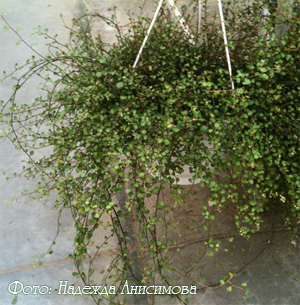
Buckwheat family. Homeland - New Zealand, Australia, South America. It grows in coastal areas, lowlands and at the foot of mountain forests, some species grow only in open sunny areas, others only in openwork partial shade under the forest canopy. Several species of outwardly very similar, semi-deciduous, densely branched shrubs or vines are common in culture.
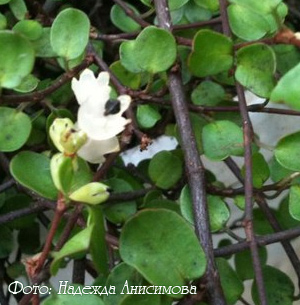
The most popular is Muehlenbeckia complexa Mühlenbekia tangled (Mühlenbekia embracing). The leaves are alternate, whole, obovate, on short petioles, usually 1-1.5 cm in diameter. In some varieties, the leaves are not rounded, but lobed, almost triplicate. The stems are brown, with a reddish tint, grow up to several meters in length, and the petioles and edges of the leaves are painted with a beautiful red tint. Inflorescences are low-flowered, racemose. The flowers are small, white, about 0.5 cm in diameter, five-petalled, flowering in August. The fruit is an achene, edible.
Mühlenbekia - care and cultivation
Mühlenbekia can be grown in a separate pot, or as a ground cover plant, planting it in buckets or tubs to dracens, palm trees, diffenbachia, monster, ferns or ficus. Its roots are powerful enough, so the pot should be spacious!
Temperature: In summer 24-26 ° С, cool in winter, optimal 10-12 ° С, in nature some species withstand frosts up to -3 ° С. On very hot days in summer or winter, especially with low humidity, some yellowing of the leaves may occur. If mühlenbekia is grown at home in winter, it is important to ensure that its leaves do not come into contact with hot air from heating batteries. And in the spring you need to prune, removing all elongated shoots.
Lighting: Bright diffused light, with some direct sun. The south window will require shading in summer on hot days. The best lighting is on the windowsill of the east or southeast window.
Watering: The soil should be slightly moist all the time, excessive waterlogging and drying are not allowed. The next watering is carried out when the top layer of the earth dries. Plants planted in the garden are also required to be watered on dry days in the morning or evening.
Fertilizers: In the period from May to August, once every 2-3 weeks they are fed with complex fertilizer for indoor flowers. Responds well to feeding with liquid biohumus.
Air humidity: Mühlenbekia has no need for regular spraying, the optimal air humidity is about 50%.
Transplant: Annually in the spring. The soil should be well drained, freely let in air and dry out quickly. An example of a soil mixture: the 1 part of clay-turf, the 1 part of sheet, the 1 part of compost and the 1 part of sand. The plant is not demanding of soil acidity and water hardness, it grows on acidic and slightly alkaline soils. You can use garden land or universal peat soil from the store, but you need to add an equal amount of coconut substrate to them, and 1/2 part of humus or biohumus.
Reproduction: By seeds, cuttings, dividing the bush, less often by branches. Seeds after pollination are ripened within a month, sown in March-April in a mixture of sand and peat. They dive into pots when a pair of real leaves unfolds. A permanent place in the garden is planted the next year, in the spring, when the threat of spring frosts passes. For vegetative reproduction, in July-August ripened cuttings of the current year are cut, 8-10 cm long, rooted in water, then planted in pots.
