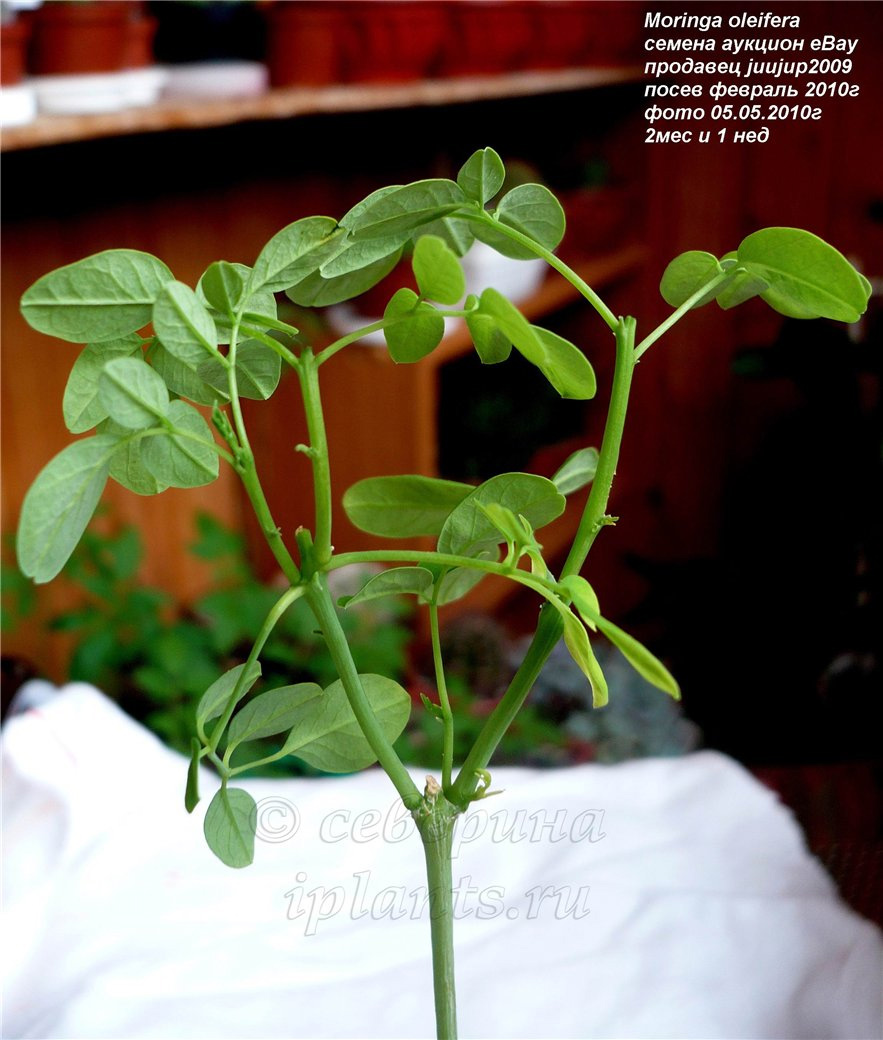
Moringian family. Homeland Africa, India, Malaysia. 13 species are common in nature.
All species can be divided into three groups: caudex forms (bottle trees), whose homeland is mainly about Madagascar. They have thickened trunks (Moringa drouhardii, Moringa hildebrandtii, Moringa ovalifolia, Moringa stenopetala). Common trees - have underdeveloped tuberous thickenings on the roots (Moringa concanensis, Moringa oleifera, Moringa peregrina), native to Arabia and India (foothills of the Himalayas at an altitude of 1400 m). Tuberous trees and shrubs - have mainly underground or semi-underground tubers (Moringa arborea, Moringa borziana, etc.) common in Somalia and Kenya. The origin of each species also dictates the conditions for keeping the plant as a room culture.
- Moringa borziana is a shrub-like plant native to Kenya, 2-3 m high. Caudex is semi-subterranean, brown, divided, the thickness of each thickening reaches 15 cm in diameter and about 1 m in length. The leaves are alternately located, complex pinnate. Each leaflet is obovate, green. The flowers are five-lobed, bisexual, with a cloying sweet aroma. Sepals are greenish at the base, reddish at the end, bent back. The petals are greenish-cream. The fruit is a pod.
- Moringa Pancake week Moringa oleifera is a fast-growing, evergreen, well-branching tree, reaching a height of 10 m in nature. The trunk diameter is 60-70 cm. They have underground tubers (about 20 cm in diameter). When grown as a houseplant, tubers are not buried, but raised above the ground. The roots smell like horseradish. The leaves are alternately located, complex pinnate (7-11 leaves), drooping. Petioles and lower part of leaflets are covered with grayish pubescence. Leaflets broadly ovate, green, notched at apex, 1-2.4 cm long. Inflorescences are racemose, up to 30 cm long. The flowers are white, less often cream, about 2.5 cm in diameter, fragrant. Petals are lanceolate, 1.5 cm long and 5-6 mm wide. Sepals are the same color and shape as the petals, with a green base, slightly pubescent.
Moringa care
Temperature: Normal in summer, optimal 20-28 ° С, cool in winter, within 12-13 ° С, not lower than + 10 ° С, with dry content, preventing complete overdrying. Moringa loves fresh air, is resistant to drafts, but not in winter.
Lighting: Sunny place. Shade may be required during the hottest hours in the summer, it is necessary to preserve the decorativeness of the leaves. Moringa will grow well on any window except the north .
Watering: Abundant in spring and summer, watering is very limited during the rest period (at low temperatures). Moringa is good in drought resistance, but loses its leaves when dried and in the heat. Its roots are powerful, in nature, even in the driest periods reach groundwater. After establishing normal irrigation and humidity, it releases new shoots. Try to avoid watering with hard water, which leaves a salt deposit on the surface of the soil. Periodically loosen the ground in pots.
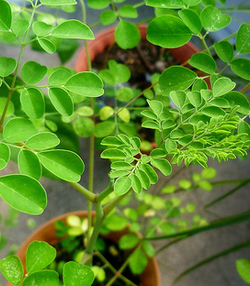
- Attention: Plants having caudex, regardless of its thickness, water them in the same mode as any other succulents.
Fertilizer: From April to August, they are fed 1 times every 2-3 weeks with liquid mineral fertilizer. It is better to alternate universal fertilizers, for example, "Pocon" universal (NPK 7 + 3 + 7), with fertilizers for flowering plants, for example, "Bona-forte" (NPK 5 + 10 + 5).
Humidity: Moringa loves high humidity. Most species in nature grow near the ocean (for example, Moringa borziana no further than 100 m from the coast), and therefore need increased humidity of 80-85%. The plants are sprayed and placed on a tray of water.
Transplant: Annually in the spring. Soil mixture: 1 part of sod earth, 1 part of sheet earth, 1 part of fine gravel (2-3 m), 1/2 part of washed and sifted sand. At the bottom of the pot, drainage is made about 2-3 cm tall. Moringa soil is not very demanding for acidity, some species grow on slightly acidic, others even on calcareous (Madagascar species), but then in nature, when growing at home, choose soil with a pH of 5.5.
Reproduction: By seeds and cuttings. Seeds quickly lose germination, after 3 months of storage in heat it is only about 10%, but much better seeds are kept cool. Sown in spring, after preliminary soaking for 2 hours in warm water, in a mixture of peat and vermiculite, dropping 1-2 cm and maintaining good moisture of the substrate.
Seeds germinate on about 7-30 days. Moringa blooms at an early age, possibly within a year after planting. Young seedlings and rooted cuttings are very sensitive to overdrying, but you need to be careful with watering.