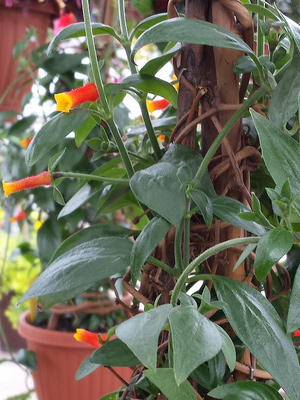
Family of madder. Homeland South America. As a houseplant, Manettia inflated Manettia inflata is common. This is a grassy vine with a soft stem that wraps easily around the support. The leaves are green, opposite, on short petioles, broadly lanceolate or ovate, tapering towards the end, about 4-5 cm long. The flowers are solitary or in small-flowered corymbose inflorescences. The corolla of the flower is tubular about 2 cm long, bright red from the base, yellow towards the end.
Manettia - Care and Cultivation
Manettia is a rare plant that can be found at home among lovers of potted flowers, but it is quite unpretentious, and the only serious requirement in care is good humidity, which, however, is not difficult to provide.
Temperature: Manettia prefers moderate temperatures, in summer about 22-24 ° C, preferably not higher than 28 ° C. In winter, cool content, within 15-16 ° C, minimum 12 ° C. Try to ventilate the room more often and do not place this plant in a stuffy kitchen.
Lighting: Bright diffused light with some direct sun in the morning or evening. It grows well on the east, north-west, north window. You can put a pot in the immediate vicinity of the south window, if it is covered with light tulle.
Watering: Abundant in spring and summer, the soil should be slightly moist inside the pot, but have time to dry out in the upper part. Watering is more moderate in winter. Manettia does not tolerate overdrying of an earthen coma or excessive dampness. Use soft warm water for watering.
Fertilizer: In a period of active growth from March to August in two weeks, liquid fertilizer for flowering indoor plants. The dose of fertilizer is taken half that recommended by manufacturers.
Humidity: Needs regular spraying. You can place a pot with a flower on a tray with wet expanded clay or gravel.
Transplant: Annually in the spring. The soil is the 1 part of the sod, the 1 part of the coniferous, the 1 part of the leaf, the 1 part of the peat land and the 1 part of the sand. Good drainage is mandatory.
Reproduction: Cuttings that are cut in February - March. Cuttings are rooted using phytohormones and soil heating. Germination soil: a mixture of universal peat soil and vermiculite in equal parts, must be sterilized.
