Myrtle family. Homeland - Australia, New Zealand, Philippines, Indonesia, tropical America. More than 200 species of trees and shrubs are common in nature.
- Melaleuca alternifolia Melaleuca is another leaf or Australian tea tree - a branched evergreen tree, reaching 7 m in height in nature. It has a thin bark of gray color, the leaves are alternately located, sitting tightly to each other, very narrow, lanceolate in shape, about 12 cm long and 0.5 cm wide. From a distance, the plant resembles a conifer. The flowers are white, fragrant, collected in spike-shaped inflorescences. The petals of the flower are small, white, rounded. Stamens white very long and numerous with yellow anthers.
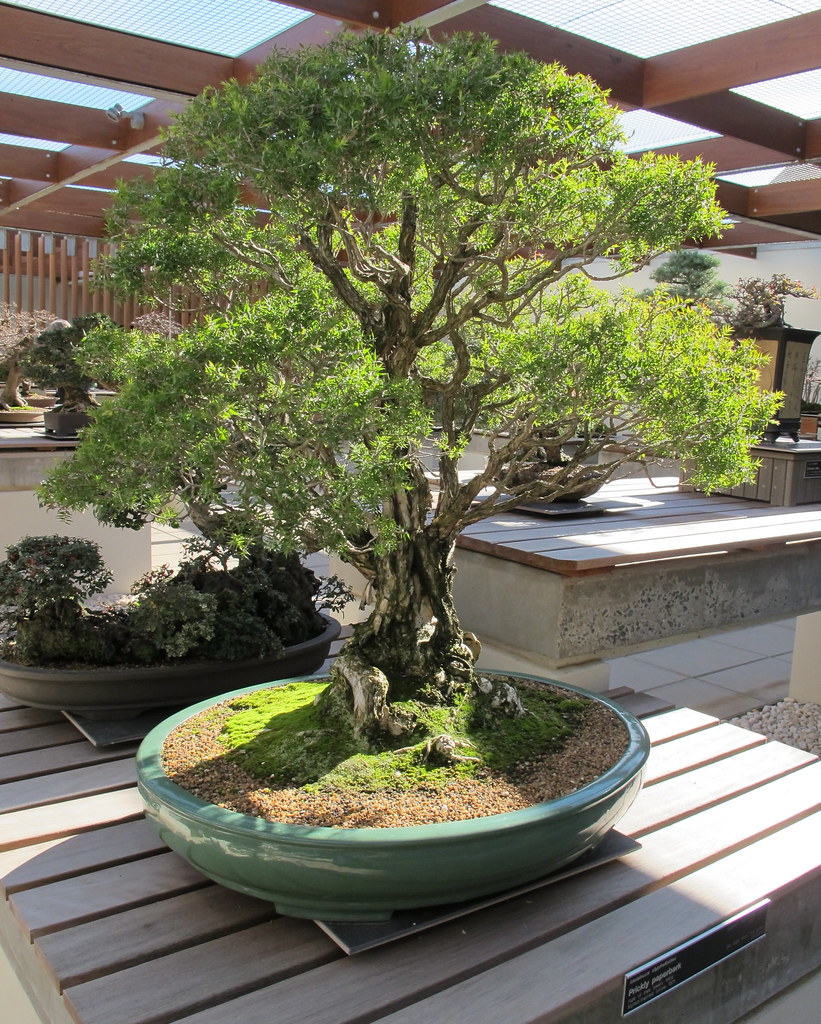


Crown formation in melaleuca is carried out by cutting and pinching shoots in spring. The plant tolerates pruning well and responds with more abundant branching. This quality is used in the formation of bonsai from malaleuki. Branches are flexible and plastic, you can form the direction with wire.
Melaleuca - Care
Temperature: moderate in summer, preferably no higher than 28 ° C. In nature, melaleuca withstands small frosts in winter, up to -7 ° C. But when growing in rooms, the optimal temperature is in winter, during the rest period + 8-10 ° C.
Lighting: full sunlight, summer shading on the south and west windows at the hottest time from 12 to 15 hours.
Watering: plentiful from spring to autumn, the day after the top layer of the earth dries up. In winter, they water so that the soil has time to dry well, but does not dry out completely. Depending on the temperature, this can be once a month (if 8-10 ° C), or once every two weeks (if the temperature is about 15 ° C). Like all myrtle melaleuca, it does not tolerate overdrying of an earthen coma, but so that the roots do not rot from dampness, very well drained soil is needed.
Trim: from March to August with complex fertilizer for deciduous indoor plants. Feeding every two weeks in full dose.
Humidity: In nature, the tea tree grows in swamps, along the coast, near streams, so it needs regular spraying. The main problem of growing in apartments is precisely the dryness of the air. Greenhouse conditions will be optimal for melaleuca. Avoid placing pots near the heating system.
Transplantation: annually in the spring, or the upper layer of the earth is replaced. Melaleuca grows well on weakly acidic soils and does not tolerate soil latching well. The soil 2-3 part sod, 1 part peat, 1 part humus, 1 part sand, 1 part vermiculite. Pour 2 cm high expanded clay drainage onto the bottom of the pot.
Reproduction: cuttings and seeds. Seeds are sown in plates in the month of March, moisten the ground well, cover with glass. The ground in the area should be damp all the time, but not too damp. The crops are regularly ventilated (twice a day for 30 minutes). Cuttings are rooted in moist vermiculite in a room greenhouse.
Interesting facts about the plant
- Australian tea tree oil Melaleuca alternifolia is used to treat minor cuts, burns, acne, fungal infections of the nails, yeast vaginal infections (thrush), as well as for cosmetic purposes - added to an aroma lamp, to a bath when bathing, for inhalation and rinsing. In
- its pure form, tea tree oil can cause irritation or allergic reactions. Therefore, it is used in diluted form (together with olive or sunflower oil).
- Tea tree oil is not used inside without a doctor's prescription! And also not used to treat mucous membranes, nose, ears.
- Cajeput oil is derived from White Tea Tree or Melaleuca cajeputi. Cajeput oil also has a bactericidal, disinfecting and wound healing effect.
