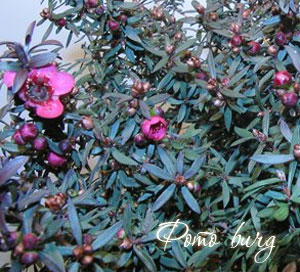
Myrtle family. Homeland - Australia, New Zealand, Tasmania. About 50 species of evergreen shrubs or trees are common in nature. Only one species is grown as a houseplant, which is quite demanding in care.
Leptospermum twig-shaped Leptospermum scoparium is a small shrub with generously branching, hairy stems. The leaves are alternately arranged, spineless, sit on the stems very often. The leaf shape is oblong or lanceolate, with a fine point at the end. Leaves about 1 cm long, up to 3 mm wide, with clearly visible venation, the lower part of the leaf is covered with pubescence. The leaves contain a fairly large amount of essential oils, which is especially noticeable if you rub the leaf between your fingers. The flowers are single, axillary, small - in diameter about 1 cm. The fruit is a box.
Leptospermum - care and cultivation
Temperature: In summer, normal, optimally 24-26 ° C, in winter a very cool content is needed, at a temperature of 7-8 ° C, but not higher than 12 ° C, with very limited, meager watering.
Lighting: Like all myrtle, leptospermum is photophilous, it needs a certain amount of direct sun, shading is mostly not required, but in spring they are gradually accustomed to the bright sun. In direct sunlight in summer, the leptospermum does not suffer from sunlight, but from heat, so it is better to rearrange the plants in a cooler place.
Watering: Plentiful from spring to autumn, after drying out the top layer of the earth. In winter, they are rarely watered, but without allowing a complete re-drying of the earthen coma. If the soil dries too much, the plant may die. Leptospermum does not tolerate hard water, so use boiled or filtered water. A sign of the need for watering in leptospermum will be the drooping of the tips of the shoots - they become sluggish, but after watering the turgor is restored. Long drying, like waterlogging, does not tolerate.
Fertilizer: From March to August, myrtle is fed with fertilizer for azaleas or bonsai. Top dressing every two weeks.
Humidity: Needs humidification in spring and summer.
Transplant: Annually in the spring. The soil should have a slightly acidic or acidic reaction. Mixture: 2-3 parts of sod, 1 part of peat land, 1 part of humus, 1 part of sand. Ready-made soil mixtures for azaleas and rhododendrons can be used. The soil should be sufficiently loose, breathable.
Reproduction: Cuttings in spring and summer, seeds. The cuttings are stuck immediately in pots, in the ground (a mixture of vermiculite and peat), closed on top with a jar or tied into a bag, ventilated twice a day for 30 minutes. Cuttings root better in February-March for 1-1.5 months. It is very important for rooting uniform moistening of the soil - so that it does not dry out, but also is not waterlogged. To do this, instead of a bag, it would be better to use a cap made of a cut-off plastic bottle (cut off the bottom, remove the lid). It is necessary to remove the shelter gradually, smoothly accustoming young plants to drier air.
The leptospermum is well formed by pruning. With the end of the dormant period from February, a crown can be formed. Plants can be cut repeatedly during the growing season. Leptospermum is formed in different styles, including with a rod tree. As a bonsai culture, leptospermum is valued for its abundant branching, small leaves, and the tendency of the bark to crack.
