Aisoonic family. Homeland South Africa - most species are native to coastal semi-deserts. In total, about 150 species are common in nature, represented by small shrubs, ground cover forms.


- Lampranthus orange Lampranthus auratiacus is a bushy plant about 15 cm tall. Shoots in young plants are erect, then they droop and creep on the ground. The leaves are fleshy trihedral. Flowers on long pedicels are pink, purple or red, with a diameter of 4-5 cm. It blooms from mid-summer to mid-autumn. The fruit is a box. Some data suggest that this species is a synonym of Mesembryanthemum aurantiacum, the status of the species is not officially approved.
- Lampranthus deltoid Lampranthus deltoides - native to the Southwestern Cape of South Africa, grows in wide curtains up to 30 cm high. It has trihedral fleshy leaves, sessile, light green with a gray tint and short reddish denticles along the edge. The flowers are light yellow fragrant, purple-pink in the center. The synonym is Oscularia deltoides.
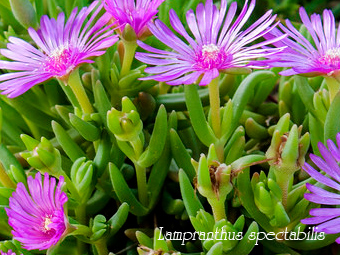
- Lampranthus splendid Lampranthus spectabilis - has juicy wax-like leaves in a trihedral shape, grayish green and resembling small children's fingers. The flowers are usually lilac with thin petals white towards the base, but there may be variations of pink, purple, white or purple.
Lampranthus - Care and Cultivation
In general, Lamprantus is undemanding in care, the beauty of this plant depends on how well you choose the windowsill in terms of illumination. Many Lamprantus species are grown in warm climates as annuals, planting them in wide containers and decorating patios and street window sills with them. With the end of flowering, they throw out, and in the spring they sow seeds again. And all because these aizoonic ones grow very quickly, the stem is exposed at the bottom and the plant loses its decorativeness. At home, it is easier to re-root the apical cuttings in early spring.
Temperature: Lamprantus prefers moderate temperatures, on sunny days in the summer you need to shade from the heat from 12 to 15 hours. In winter, the rest period at a temperature of 10-12 ° C, at least + 8 ° C, without watering .
Lighting: Bright sun throughout the year. The sill of the south window is best. In nature, lampranthus grows on mountain slopes without shading. In room conditions, in low light conditions, illumination with fluorescent or LED lamps will be required.
Watering: Moderate in spring and summer. Watered very carefully, the roots easily rot from excess water. After the top layer of soil has dried (dry to the touch), wait a few more days before watering again. During the dormant period during cold wintering, the soil is only occasionally slightly moistened, literally a teaspoon of water.
Fertilizer: May to September every other week. Fertilizer for ornamental flowering plants, take at a dose half as much as recommended by the manufacturer or use fertilizer for cacti.
Humidity: In summer, on especially hot days, you can moisten the air around the plants from a very small sprayer, preventing water from remaining on the leaves in the form of drops.
Transplant: Carried out when the roots fill the entire pot. Any soil mixture for succulents is suitable. But you can make your own soil: 1 part of the universal land (or garden), 1 part of the sand, 1 part of the gravel crumb, 1 part of the coconut substrate.
Reproduction
Seeds sown in winter and early spring and cuttings cut in summer. Seeds can be sown in a mixture of peat and vermiculite (or sand) taken in equal parts. Surface crops, pour seeds by 1-2 mm. Moisten from the spray bottle and cover with glass. Do not forget to ventilate crops. As soon as seedlings appear, you need to provide very good lighting and gradually accustom them to live without covering the glass, to the usual humidity. After the real leaves appear, the lamprantus seedlings can be planted in separate pots. But this is not necessary - this succulent grows in curtains, thickets, so if you do not want to plant seedlings, you can sow using a different technology: pour drainage into wide pots, then soil, as for adult plants (described above), then a layer of coarse washed river sand, about 5 mm. N him and carry out crops. Seedlings will grow up, grow roots and continue to grow quietly without transplantation.
