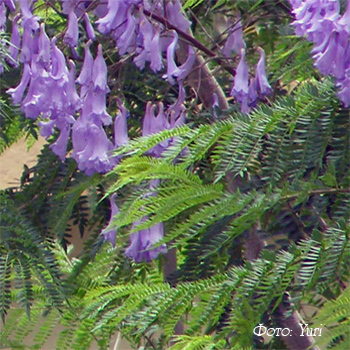
Bignonium family. Homeland Central and South America. There are about 50 species of huge, beautifully flowering trees in nature.
-
At
- home, only one species is grown - Jacaranda mimosifolia, originally from Brazil and Argentina. This sprawling tree, in nature reaches an average of 5-10 m (in an apartment about 1.5-2 m tall), with leaves similar to those of ferns or mimosa twice pinnately dissected, reaching 40 cm in length. The bark is gray, reddish on young shoots. The flowers are tubular, elongated, about 5 cm long, blue-violet in color, collected in racemose inflorescences. Flowering, very abundant, begins in spring. Jacaranda blooms in sunny spacious greenhouses and winter gardens. In warm regions of Europe and the USA, where winter temperatures do not fall below -3-5 ° C, it is often grown on the streets and in parks, and it is also widespread in Australia. There is a variation of the jacaranda that is transient with white flowers .
Jacaranda is grown from seeds sold in flower shops. When buying, pay attention to the packaging period - buy only fresh seeds!
Jacaranda - care
Temperature: in summer, the usual room temperature, optimal for the plant is about 20 ° C, does not tolerate strong heat at low humidity, on such days the pot with the plant should be placed in a cooler place (for example, on the floor near the window). In winter, it is necessary to lower the temperature, optimally about 15-16 ° C, at least 10 ° C (although it can withstand short-term frosts in nature, domestic plants are not accustomed to this).
Lighting: bright diffused light, with some direct sun. It grows well on windows of western and eastern orientation. On the southern windows, shading on sunny days at noon. On cloudy days, even on the southern window, shading is not needed.
Watering: plentiful in spring and summer, the soil should have time to dry out in the upper half of the pot. Since autumn, more moderate, the soil should dry well, but not dry completely to dust. Jacaranda equally poorly tolerates complete drying, and the bay, when the land dries for a very long time - if this happens, then the soil is not correctly selected (too dense, not loose). When the soil in the pot with jacaranda dries up a lot, it begins to lower the leaves, but as soon as it is watered, it lifts them again.
Top dressing: during the growth period from April to August, once a month jacaranda with special complex fertilizers for deciduous indoor plants.
Air humidity: Jacaranda loves moist air, so the plant is regularly sprayed, and during dry hot days it is worth putting on a wide tray with wet expanded clay or sphagnum moss. Water from the tray should not flow into the pot.
Transplant: in the spring, when the roots will fill the whole pot. Soil is a mixture of 1 part of sod, 2 parts of sheet (peat) land, 1 part of humus land, 1 part of fine gravel. In nature, Jacaranda grows on light sandy loam, well-drained soils, does not tolerate swampy and clay soils. Therefore, a high drainage is made in the pot, and large river sand or vermiculite sifted from dust is added to the ground when planting. The optimum pH is 6.5.
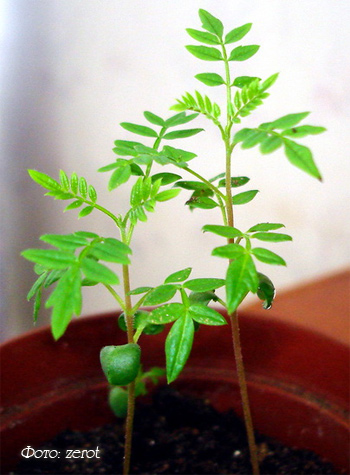
Breeding: stem cuttings in summer. Seeds in spring. Seeds do not require any pretreatment, germination is usually high, shoots appear 2-3 weeks after sowing, but the substrate temperature should be at least 25-27 ° C. Sown in a mixture of sand and peat (or vermiculite and peat), constantly maintain the soil in a slightly moistened state, ventilate at least twice a day.