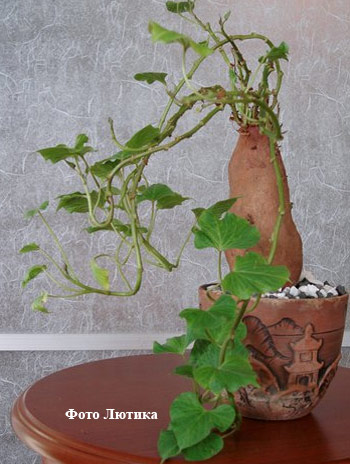
Bindweed family. Ipomoea in translation from Greek. 'ips' - worm and 'homoios' - similar - in the structure of the underground rhizome of many original species.
Until recently, the name of the morning house was associated only with balcony and garden floriculture. But amazing vines appeared on sale, growing not from the ground, but from funny potatoes. It is this "potato," which sometimes is not a potato at all, but a whole "pumpkin" or "bottle" and is a value for room culture and morning glory. Unfortunately, there are almost no descriptions and recommendations for caring for this caudex vine in the literature. And therefore, here we will talk about it - about the caudex form of potted morning glory.
- Caudex forms of morning glory are represented by several species: Ipomea yam Ipomoea batatas, Ipomea white-billed Ipomoea albivenia, which are distributed mainly in a number of African countries (Angola, Namibia, Botswana, Zimbabwe, Zambia, Tanzania) and tropical areas of the Americas (Paraguay, Argentina, Mexico) The rhizome of the hypomei is often different - in some they are exclusively underground (usually in African species), in others they are superficial, they can be elongated or spherical, some form multiple tubers, like potatoes, others are braided in a bizarre knot. Shoots of morning glory resemble a vine - the same long lashes.
In addition, African species of the morning glory are somewhat different in care from the morning glory, which comes from the tropics of America. The fact is that African species are more hardy in relation to direct sun and dry air, as well as require more limited irrigation and poorer calcareous soil. Therefore, you should pay attention to the homeland of the species you have acquired.
Outwardly, the morning glory also differ in the structure of the leaves - in some species the leaves are narrow and long, like in sedge or willow, in others they are pinnately dissected, resembling passiflora leaves, in others they are wide-hearted. And only the structure of the flower is always the same - a funnel-shaped fused corolla with a more or less narrow tube. On the basis of the original species of morning glory, a huge number of varieties have been bred, differing primarily in the size and color of flowers and leaves - variegated forms are especially beautiful.
Hypomea care
Temperature: Morning heat-loving plants. In summer, if the plant is taken out onto the balcony, it is necessary to protect it from sudden changes in night temperatures, from strong wind and rain. All morning glory in natural conditions a pronounced dry and warm period of rest. In apartments, it manifests itself in the fact that with a natural decrease in lighting and a decrease in temperature on the windowsill, it is necessary to significantly reduce watering. The minimum winter temperature should not fall below 12 ° C, optimally 15-16 ° C.
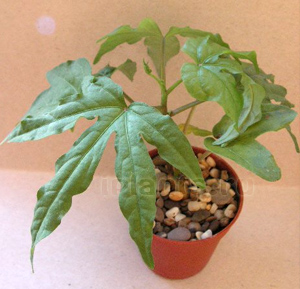
Lighting: needs a very bright location, requires some direct sun, but shading in the midday hours is mandatory, otherwise burns remain on the leaves. This also applies to American and African species of morning glory - the whole thing is that in indoor conditions plants adapt to some shading and a shorter daylight hours, so in spring they are gradually accustomed to the sun. Although in nature, African morning glory grow in full sun.
If, in addition to the lack of flowering, the leaves of the morning glory acquire a lighter lime shade, then the reason is the lack of lighting. If you do not have south windows, then in winter you may need additional lighting.
Watering: watering moderate, the soil should have time to dry in the upper layers. In winter, watering is limited, depending on the temperature 1 once every 3-4 weeks. Ipomei native to Central America like a wetter substrate than species of African origin and do not tolerate a complete overfilling of the earthen coma.
Humidity: Responds well to regular leaf spraying. If the tips of the leaves begin to dry, then this is most likely caused by too dry air, especially on hot summer days. Spray the plant in summer 2 times a day.
In addition, if the humidity is too low, the morning glory is prone to damage by spider mites. To cope with the pest or as a prevention, the hypomea can be washed under a hot shower (45-50 degrees) for two minutes. Repeat every 10-14 days.
Feeding: carried out during the growth period from March to August every 2-3 weeks. Fertilizers for cacti or fertilizers for ornamental-flowering plants that do not deoxidize the soil are used. Fertilizers containing a large dose of nitrogen cause the growth of leaf mass, and in some cases can lead to the fact that caudex becomes loose and cracks - like the skin of a cactus overfed with nitrogen.
Transplant: in February - March annually. Morning glory prefers loose, liquid-permeable and breathable soil, with acidity close to neutral or slightly alkaline. Do not add sphagnum moss to the soil - it deoxidizes the soil, and the morning glory does not like acidic soils. Good high drainage to the bottom of the pot is mandatory for all morning glory.
- Substrate for African species: 1 part of coconut fiber, 1 part of leaf humus, 1 part of vermiculite, 1/2 parts of fine expanded clay (3-4 mm), pieces of charcoal. You can use a purchased soil mixture for cacti, which also needs to be diluted with fine expanded clay and vermiculite.
- Substrate for American species (and India): 1 part of coconut fiber, 2 part of leaf humus, 1 part of peat, 1 part of vermiculite, 1/2 parts of fine expanded clay (3-4 mm), pieces of charcoal.
Reproduction: Caudex forms of morning glory reproduce only by seed or tuber division. Rooting of cuttings is possible - the plant will take root and bloom with proper care, but does not form caudex, and care will be required as for an ordinary indoor plant. Seeds are sown after preliminary soaking into a light mixture of peat and river sand. They germinate at a temperature in the range of 18-20 ° C.
Growing problems
Tuber decay from excessive waterlogging of the substrate. Do not forget that watering should be determined not by the time of year and days of the week, but by the state of the soil. Periodically loosen the ground in a pot so that you can check it with your finger at a depth of 4-5 cm - it should be almost dry by the time of the next watering.
If you notice softening or dark spots on the morning glory tuber, first of all, remove the plant from the pot and check the roots and soil in the depths. If it is not dry enough, then you need to dry the roots, powder with crushed charcoal and plant in fresh earth.
Sudden browning of leaves at the edges, wrinkling of caudex or its decay can also be caused by improper fertilization - a burn from too concentrated dose of fertilizer or too frequent fertilization.