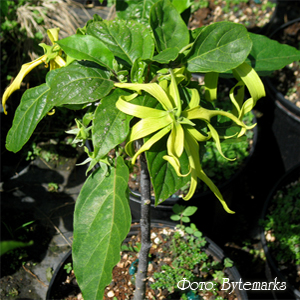
Family of announced. Homeland: Philippines, Indonesia, Madagascar .
- The Ylang-ylang tree "Cananga odorata" has a straight trunk about 3 m tall or more, with grayish-silvery bark. The branches are a little drooping, well leafy. The leaves are dark green, up to 20 cm long, oblong in shape, pointed at the end with a wavy edge. Flowers in axillary inflorescences in natural conditions appear year-round. Flowers about 8 cm in diameter, very fragrant, first greenish-yellow, then bright yellow. Forms greenish fleshy fruits resembling olives, about 2 cm in diameter. The dwarf variation Ylang-ylang Fruticose Cananga odorata var is grown at home. fruticosa.
Ylang Ylang: Home Grown
Originally from the Pacific Islands, this tree is a tropical plant, and therefore grows well in high humidity. You need to plant it in a spacious pot, always with good drainage. Ylang-ylang loves fresh air, and its growing conditions should be as close as possible to greenhouses. Therefore, if you have a conservatory or a well-insulated balcony, this is the best option for this exotic plant.
Temperature: in the spring-summer period in the range of 22-26 ° C during the day and 18-22 ° C at night. In winter, within 12-14 ° C, but not lower than 10 ° C - it is advisable to observe a rest period of at least 2 months. Ylang-ylang likes daily temperature fluctuations to make it 5-6 ° C cooler at night.
Lighting: bright sunlight, partly direct sun. In winter, additional lighting is possible using lamps (fluorescent or LED).
Watering: plentiful in summer, as the top layer of the earth dries up. In winter, with a decrease in temperature - moderate or limited, the soil should have time to dry out thoroughly.
Top dressing: from March to August once a month top dressing with fertilizer for flowering plants.
Humidity: It is best to put the pot on a wide tray with wet pebbles or moss-sphagnum. Optimal humidity is 60-70%. The plant is especially badly affected by the dry air of heating systems in winter.
Transplantation: annually in a mixture of the 1 part of the sod earth, the 1 part of the humus, the 1 part of the sheet earth (or peat) and the 1 part of the small gravel. Also add chunks of charcoal and a handful of pine bark. A ready-made soil mixture for palms or ficuses can be used, but gravel (2-3 mm) or vermiculite can be added to it at the rate of 1 liter of baking powder per 5 liters of soil. The acidity of the ylang-ylang soil is quite tolerable, but it is better if it has a slightly acidic reaction. Choose a deep pot, since the root system of the plant is tapered.
Reproduction: cuttings (if brought from a tourist trip) and seeds. Fresh seeds should take care. Seeds stored for about 5-6 months have the best germination. Before sowing, it is better to soak the seeds in hot water and bubble. You can soak them in a zircon solution.
