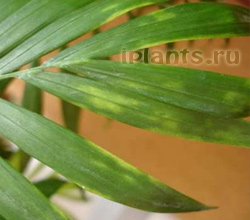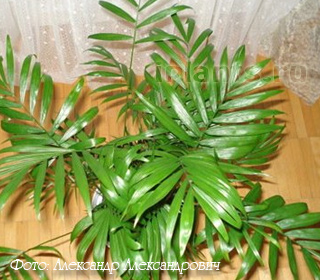
Areca family (palm). Homeland Central America. The genus includes about 100 species. This is one of the most adapted for indoor palm keeping, as it grows rather slowly and tolerates some shading well. In addition, this palm tree blooms at a young age.
The graceful hamedorea, Chamaedorea elegans, is native to the rainforests of Mexico and Guatemala. Rhizome plant forming a spreading bush. The leaves are pinnate, each of individual lanceolate leaflets. The flowers are male and female, male light yellow or orange, collected in a loose panicle, female flowers are single, orange. It blooms at any time of the year. In indoor conditions, hamedorrhea grows about 1 m tall and about 1.5 m in leaf span (in nature 2-2.5 m tall). Notable synonyms: Neanta beautiful Neanthe bella, Collinia graceful Collinia elegans.
Hamedorea is well grown in the company of plants such as marant and decorative-deciduous begonias. They require approximately the same conditions of detention.
Hamedorea - home care
Temperature
Moderate, for optimal growth it is desirable 18-20 ° С, and in winter (from October to February) cool about 12-15 ° С. For summer, it is better to expose the plant to fresh air in the garden or on the balcony, with the obligatory shading from direct sunlight. Drafts should be avoided. Of course, in ordinary apartments it is rare when the temperature is kept for a long time in the boundaries ideal for palm trees, but hamedorrhea is rather unpretentious, adapts to ordinary room conditions, but only in greenhouse conditions, where there is a lot of space, light and quite cool, truly beautiful and spreading specimens grow.
Lighting
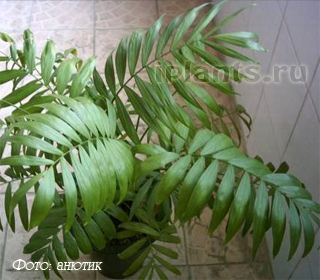
A bright place, with some direct sun in the morning or evening, light partial shade, protection from direct sunlight in the midday hours is required. The room is suitable for a place near the east and west windows. If the room is warm in winter so that the plant does not lose leaves and does not stretch out, additional illumination may be needed.
Watering
In spring and summer, plentiful, moderate or limited in winter, but watering directly depends on the air temperature, the higher the temperature in the room, the more often watering. Both drying and waterlogging are equally poorly tolerated, but excessive dampness, long-drying earth very quickly lead to the formation of rot and death of the plant.
Fertilizer
From March to August, fertilizer watering is carried out after 2 weeks, with liquid fertilizer for indoor ornamental and deciduous plants.
Air humidity
Hamedorei love very humid air, optimally 55-60%. With dry air (especially if heating is turned on), this plant is often affected by a spider mite. To avoid this, the palm is regularly sprayed, two to three times a day. You can put the pot on a wide tray with wet sphagnum moss.
Flight connections
Transplanted when the roots fill the entire pot or tub. Soil - 2 part of light turf, 2 part of humus (or compost), 1 part of peat land or leaf, 1 part of sand and several pieces of charcoal. Sheet or peat land can be replaced with the same volume of coconut substrate (from pressed briquettes). Make a high drainage to the bottom of the pot (it is better to use large expanded clay, or pieces of foam (1.5-2 cm)).
Over time, the ground in the pot is compacted, and the root neck of the chamedorrhea is exposed, so the ground must be periodically loosened so that the roots breathe, dry better after watering. And, in addition, they add land in the area of the root neck. If a white salt deposit appears on the surface of the earth (which means your water is too hard, you need to boil it), it must be removed and replaced with fresh earth.
Reproduction
The palm is propagated by seeds, at a temperature of at least 24 ° C, it is better to sow in a room greenhouse, the seeds are large, they can be planted individually immediately in peat tablets. Hamedorrhea is also propagated by root offspring or by dividing the bush. But it tolerates the procedure painfully, any injuries lead to inhibition of already slow growth and loss of lower leaves. Therefore, when dividing, it is important not to tear the roots with your hands, but to carefully cut off a small part of the leaves with roots from the side.
For more on palm cultivation and cultivation, see Palm trees