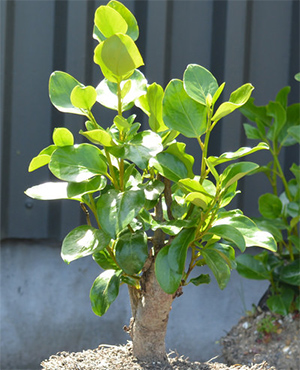
Dogwood family. Homeland New Zealand, almost everywhere at an altitude of up to 1000 m from sea level, as well as Brazil, Chile.
Coastal griselinia griselinia littoralis is an evergreen branched shrub, 1.5-2.5 m high and above. The leaves are green alternate, leathery with a glossy surface, ovate-oblong in shape, with a slightly wavy edge, dulled at the apex, about 5-10 cm long. Inflorescences are small axillary panicles, consist of tiny green or green-yellow flowers, and do not represent any decorative value. The flowers are dioecious, pollinated by insects. The fruit is a purple berry, bitter but edible. There is a species of Griselinia littoralis variegata with variegated leaves.
Griselinia - care and cultivation
Temperature: moderate in summer, griselinia does not like heat and stuffiness. In winter, the rest period at a temperature of about 7-8 ° C, almost dry. Griselinia is frost-resistant, can winter with good shelter at a temperature of at least -10 ° C. For winter, an insulated balcony is perfect.
Lighting: light, but shaded from the direct sun. Ideal southeast or northwest window.
Watering: plentiful from spring to autumn, the soil should be constantly moist in the depths of the pot and dry in the upper half. Watering is rare in winter, the soil should have time to dry well. One of the advantages of griselinia is that it is not demanding on the hardness of water, at home, it is accustomed to demolish irrigation with salty sea water, endure the wind, and the only thing that it does not tolerate is a long drought.
Top dressing: from April to August, fertilizers for ornamental and deciduous plants are fed every two weeks. You cannot feed the first month and a half after the transplant.
Air humidity: requires high humidity, it is advisable to spray at least once a day, you can put the pot on a wide tray of water.
Transplantation: the soil should be nutritious and very porous. Earth mixture: 2 parts of turf, 2 parts of sheet (peat universal), 2 parts of small gravel or marble chips (particles 3-4 mm). Transplantation is carried out annually, or every two years in the spring. Good drainage to the bottom in the form of clay shards or nut shells (hump up). Soils on which griselinia grow in nature (light sandy and medium loamy) have a slightly acidic to slightly alkaline reaction when the pH exceeds 7. Griselinia does not tolerate too acidic soil. For a plant about 60-80 cm high, you need a pot with a capacity of 2-3 liters.
Reproduction: seeds - in the spring, and the seeds quickly lose germination, so you need to use only fresh ones. Sowing in a mixture of universal soil and vermiculite in equal parts. Seed germination at a temperature of 24-25 ° C with uniform moistening. It can be propagated by stem semi-woody cuttings cut in early summer .
