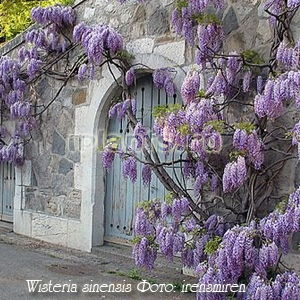
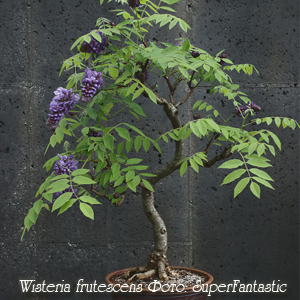
Legume family. Homeland East Asia. About 7 species of wisteria and several forms or subspecies are common in nature. In natural conditions (in the Caucasus, Crimea), wisteria winters without shelter, and its dimensions reach 3-4.5 meters in height. In an apartment, wisteria will eventually reach the ceiling and will have to be cut or updated, some species are formed as potensai (pre-bonsai). The simplest option for the formation of wisteria is in the form of a stamen tree, but from the point of view of form, wisteria is a polulian and can and should be tied to a support. In the garden, it somewhat resembles grape bushes, so it is often grown along fences, as a flowering hedge, near arches.
With the onset of warm days in summer, wisteria is taken out into the garden, onto the balcony or veranda. Huge beautiful caps of wisteria flowers, unfortunately, are not suitable for cutting, because quickly wilt.
- Wisteria or Wisteria Chinese Wisteria sinensis is a beautiful climbing plant, far from the best option for indoor cultivation, but subject to conditions, it can grow well and bloom in a greenhouse or conservatory. The leaves are light green, oblong in shape, pointed at the end. Young leaves are covered with dense pubescence, with age they become almost bare. Numerous flowers are collected in racemose inflorescences about 20 cm long. The color of the flowers is light purple, blue, pink or white.
Caring for Wisteria
Temperature: normal in summer, preferably kept outdoors. In winter it is very cool 6-8 ° С. You can place wisteria for the winter in a basement room that does not freeze until mid-January. And then, gradually increasing the temperature, i.e. rearranging in warmer and lighter rooms, by the end of February you can contain wisteria at normal room temperature. If wisteria is kept in a heated warm room in winter, the plant will not only not bloom, but may also die.
Lighting: wisteria is photophilous, requires full sunlight. If in late winter, early spring, wisteria stands at the southern window, it quickly blooms, then after a short break it blooms again at the end of summer, but there are already much fewer flowers.
Watering: from spring to the end of summer, watering is moderate, the soil should be slightly moist all the time in the depths of the pot, but dry in the upper layers. Wisteria does not tolerate excess water, or rather long-term drying of the soil - the substrate should be very loose. During cold wintering, watering is very rare and scarce.
During the period of budding and flowering, once a week they are fed with liquid fertilizer for flowering indoor plants.
Humidity: Responds well to regular spraying in summer.
Transplantation: the soil for wisteria should be nutritious - a mixture of 3 parts of turf, 1 parts of leaf, 1 parts of humus and 1 part of sand. Young plants are transplanted annually, adults and old wisteria after a few years. In July, the side branches are trimmed, which are shortened by half, this contributes to the better formation of flower buds.
Breeding: Wisteria are propagated by branches and cuttings in early spring.