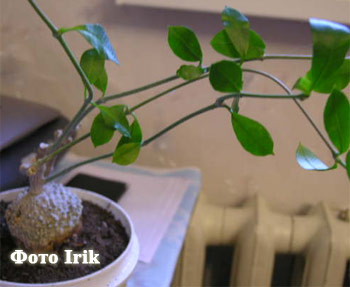
Cootra family, flipper subfamily. Homeland South and East Africa (Angola, Namibia). There are about a dozen species in nature.
These are caudex plants that have various thickening shapes at the bottom of the trunk. In some plants, caudex grows spherical and reaches more than a meter in diameter, in others it stretches like a bottle. The stems are quite thin, over time woody below and long, requiring a garter. On the breakdown of shoots or a cut of caudex, milky juice is released, like euphorbia, containing rubber. The leaves are opposite, on short petioles, dense bright green, oval, pointed at the end, wavy (in almost all species, and in Phocaea curly Fockea crispa - strongly corrugated), with a pronounced central vein. The flowers are small, only up to 1.5 cm, fragrant. The fruit is a grey-green pod.
Caring for Fokey
Temperature: normal room temperature in summer, they tolerate the heat well, but a spider mite can appear on the leaves. Phocaea requires a period of rest at dry content at temperatures of 8-10 ° C. Some species of foca lose their leaves during the dormant period.
Lighting: needs a very bright location, on the south window. Shading is only required for caudex on hot, sunny days in summer (otherwise it dries up and cracks form). In nature, phocaea grow in full sun and under the cover of shrubs and trees.
Watering: watering moderate, the soil should have time to dry well. In winter, with a lack of light and with a decrease in temperature, watering is almost stopped (little by little once a month ).
Air humidity: responds well to regular spraying of leaves (water should not flow down the caudex). If the size of the plant allows, then you can wash the leaves under the shower once a week, protecting the ground and caudex from moisture.
Feeding: carried out during the growth period from March to August every 2-3 weeks. Fertilizers are used for cacti. You can take fertilizers for other indoor plants, for example, Kemiru Lux, but breed at a dose half the recommended one.
Transplant: in the spring annually, while the lower part of the caudex is dropped. Phocaea prefers well-drained, loose, moisture-permeable soil, with acidity close to neutral or slightly alkaline. You can take purchased soil for cacti, add small expanded clay or gravel, and sand. When compiling the soil, coconut fiber is also used, instead of purchased land - leaf humus, vermiculite, pieces of charcoal.
Reproduction: Caudex forms of phocaea reproduce only by seed. Rooting of cuttings is possible, but the plant will not have caudex.