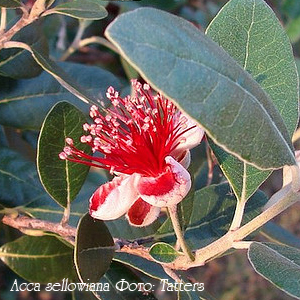
Myrtle family. Homeland - South America. 3 types of Akki have official status.
Known to florists who love fruit exotics, Feijoa has the botanical name Akka Sellova Acca sellowiana (an obsolete synonym of Feijoa Sellova Feijoa sellowiana) is an evergreen tree or shrub that grows up to 4-6 meters in height under natural conditions. The leaves are opposite, oval in shape, dense and leathery. On the upper side are gray-green, on the back - silver. Flowers on long pedicels are single or collected in rare axillary inflorescences, not large, - about 3-4 cm in diameter. The flower has 4 petals, rather dense, strongly bent back, red inside, white outside. Numerous long stamens protrude beautifully from the center of the flower. Stamen filaments are red, anthers are bright yellow. They make the flowers very spectacular. The fruit is an edible berry with small seeds.
Feijoa at home
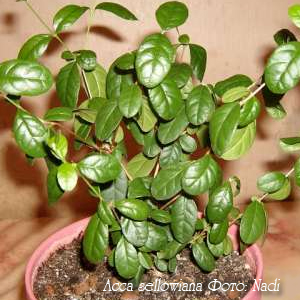
Temperature: Like all myrtle needs moderate temperatures, does not like extreme heat. In winter, prefers 12-15 ° C, at least 10 ° C.
Lighting: Feijoa is a light-loving plant, grows well on the western and eastern windows. On the south window in the summer you will need shading in the form of a mosquito net. If trees grow from the side of the street, then shading will not be required.
Watering: Plentiful from spring to autumn, but avoid excessive dampness. Feijoa, like all myrtle, does not tolerate overfilling and waterlogging. Therefore, after watering, dry the top layer of the earth (in the depths, the earth should remain only slightly moist). In autumn and winter, water so that the soil just does not completely dry out. I.e. after the top layer of the earth dries, wait 3-4 days before the next irrigation. In myrtle, some leaf subsidence is allowed when dried. After watering, the turgor is restored. But this is permissible only in a moderate temperature zone. In the heat, the earth dries up very quickly and the plant can die from drying. When watering, it is better to use warm soft water.
Top dressing: from March to August, feijoa is fed with complex fertilizer for indoor plants. Top dressing every two weeks.
Air humidity: Although feijoa is considered a plant resistant to dry air, in hot summers and winter, in the absence of the ability to keep the plant in a cool room, spraying is necessary. To make the plant feel good, develop and bear fruit, spray it once a day with warm, soft water.
Transplant: annually in February - March. Feijoa does not tolerate alkaline soil and does not tolerate root damage well. Composition: 2-3 part of sod, 1 part of sheet earth, 2 part of humus, 1 part of sand. Make sure to do good drainage. For better looseness of the soil, you can add a handful of chopped pine bark to the pot.
Reproduction: cuttings and seeds. Semi-lignified cuttings are cut in late spring, they take root very difficult, it is advisable to use phytohormones. Fruiting of feijoa grown from cuttings usually begins at 3-4 years of age. In plants grown from seeds from the age of 5.
Keeping fit: feijoa has a rather convenient tree shape for forming - in nature it grows very sprawling, forms many shoots, is easily formed by pruning and pinching. In room culture, it is recommended that a plant grown from a stalk or seed pinch the top of the shoot at a height of about 15 cm. Then, on new branches during the summer, pinch the ends of the shoots again. Plants of older age in summer, under favorable conditions, can bloom on shoots of the current year, so they can be cut only in autumn. Feijoa from the handle blooms for 2-3 years, from the seed - for 5-6 years.