Myrtle family. Homeland - mainly South America (Venezuela, Colombia, Brazil), Mexico, found in Australia and New Caledonia and Madagascar. Only about 1000 species of evergreen trees or shrubs. The genus is named after Eugene of Savoy Eugen von Savoyen - the famous commander of the Roman Empire. Sometimes the name of the genus is translated in the literature as Eugenia (as the first letter sounds in the original), but in Russian the usual sound of Eugene.
Eugenia uniflora is a tree native to the east coast of South America, 5-8 m tall in nature. The leaves are opposite, oval-lanceolate, pointed at the end, 4-5 cm long, dark green above and paler on the reverse side. Young leaflets have a bronze color. The flowers are white, on long pedicels, solitary, axillary, usually covering shoots from the middle to the apex. Corolla four-petal, about 4 cm in diameter, many white long stamens with yellow anthers, attract bees. The fruit is a ribbed berry about 2.5 cm in diameter (at home about 1.5 cm), as it ripens, it changes color from orange to maroon, each fruit contains no more than two seeds. It begins to bear fruit for 2-3 years when grown from seed. This species has several folk names - Pitanga Pitanga (which means "red" in the native language of the indigenous population of Brazil - according to the color of the fruits), Surinamese cherry.
Plants are grown as bonsai, as Eugenia is single-flowered, lends itself well to crown formation, branches very well, and is suitable for many styles.
Pitanga has edible fruits, the indigenous population of South America and Mexico for many centuries used them to prepare tonic and alcoholic drinks, cooked jams, jellies, made candied fruits and ice cream from them. Such widespread use prompted scientists to develop new varieties that differ in fruit size, chemical composition, and sugar content of fruits.


As a houseplant, including potensai and bonsai, Eugene also grows the Brazilian Eugenia brasiliensis, better known as Grumichama Grumichama. In nature, it is a tall tree, reaching 9 m in height. It branches well, the leaves are oval or elliptical, pointed at the end, larger than that of Eugenia single-flowered, 8-12 cm long and about 4-5 wide, the fruits are dark purple with cherry taste, about 2.5 cm in diameter. In its homeland, it is considered as an endangered species that needs to be taken under supervision. It grows quite slowly, forming well by pruning. By the way, the leaves and bark of Eugenia of Brazil contain essential oils and some substances useful in various diseases. In particular, an infusion of leaves (10 g dry per 300 ml of boiling water) in Brazil is used for rheumatism as an astringent and diuretic.


Eugenia victoriana - the name of the species was dictated by the surprisingly large size of the fruit - the largest of all Eugenia species - almost 10 cm in diameter. The plant blooms for 3-4 years, forms bright orange sour-tasting, very fragrant fruits. The local population of South America uses these fruits to make fermented soft drinks (like our kvass). The leaves of this species are long, elliptical, 10-12 cm long and 2.5-3 cm wide, but the plant itself in nature is much lower than other species - it forms a branched shrub up to 3 m in height.
In addition to these species, other species were grown as indoor bonsai, for example, Evgenia usikotsvetkovaya or Evgenia myrtolisty. But, over the past decade, there have been major changes in plant taxonomy related to the development of such science as genetics and allowing at the cellular level to determine the difference and similarity between plants. Therefore, now many plants have changed their names, and not only species, generic, but some even changed the family (see The Plantl list).
- The species formerly known by the name Eugenia usicotvetkovaya Eugenia cauliflora no longer belongs to the Eugenia genus Eugenia, now it is Plinia peruvian Plinia peruviana (myrtle ).
- The species formerly known by the name Eugenia myrolyst Eugenia myriophylla no longer belongs to Eugenia's genus, now it is Blepharocalyx myriophyllus (myrtle). It's scary to say - this genus does not even have the correct Russian translation! Blepharocalyx - almost monotonous with the name of the disease, I will not name, the genus has only 4 species .
- The species formerly known by the name Eugenia fragrant Eugenia aromatica or clove tree no longer belongs to Eugenia genus Eugenia, now it is Syzygium fragrant Syzygium aromaticum (myrtle).
- The species formerly known by the name Eugenia iambos Eugenia jambos, or pink apple, is no longer in Eugenia's genus Eugenia, now it is Syzygium iambos Syzygium jambos.
- The species formerly known by the name Eugenia javanica, or jambu semarang, Javanese or waxy apple, no longer belongs to Eugenia's genus, now it is Syzygium samarangen Syzygium samarangense (myrtle).
- The species formerly known as Eugenia aqueum, or water rose apple, no longer belongs to Eugenia genus, now it is Syzygium aquum Syzygium aqueum (myrtle).
Eugenia - care at home
Temperature: normal room temperature in summer, moderate preferred. In winter, cool content (with limited irrigation), for most species 15-17 ° C. Despite the fact that Eugene is quite cold-resistant under natural conditions, when growing in a pot, the temperature near it should never drop below + 8 ° C, but traditionally the winter minimum is 12 ° C. Brazilian eugenia is more thermophilic than other species, wintering well at 18-20 ° C. Eugene, like other myrtle ones, does not like sharp temperature drops, cold draft. When it comes to cold wintering, pot insulation is always meant. Cold wintering in a small bonsai pot is not allowed - the plant will dry out and hypothermia. If you have bonsai, the dormancy period should be at 15-17 ° C for any species. Old plants in large pots need to be insulated by putting them in a wide box with dry sawdust or wrapping the pot in foam rubber.
Lighting: Eugenie is photophilous, needing a bright spot when the sun hits the leaves in the morning or evening. Shading may be required only in the hottest hours of the day from 11 to 15 hours. Preferably, the southeast window, not shaded from the street, even on the east window, the intensity of sunlight is too low. On the southern and southwestern windows on sunny days it is very hot, the soil in the pots quickly dries up, the leaves burn out (turn red).
Watering: plentiful from spring to autumn, after watering the soil should dry out in the upper half of the pot, especially careful watering should be monitored if Eugene is grown as a pre-bonsai or bonsai in a bowl. In this case, check the soil daily, if it has dried to the touch at a depth of 2-2.5 cm (one phalanx of a finger), then you need to water. If not already, check in 6-8 hours. In winter, eugenia is watered less often, but immediately after the soil completely dries. Plants planted in plates are watered abundantly from a watering can (several times until the soil is moistened evenly), or by immersion for 5-10 minutes in a basin with warm (not cold) water. Soft boiled water is used, Eugene does not tolerate hard water.
Eugene does not tolerate strong drying, drops leaves. But he also does not tolerate systematic waterlogging. In general, she loves that the watering would be uniform, i.e. there were no jumps from overdrying to too abundant watering. The single-flowered Eugene species is more sensitive to overflow than other species; it must be watered after making sure that the soil is dry enough.
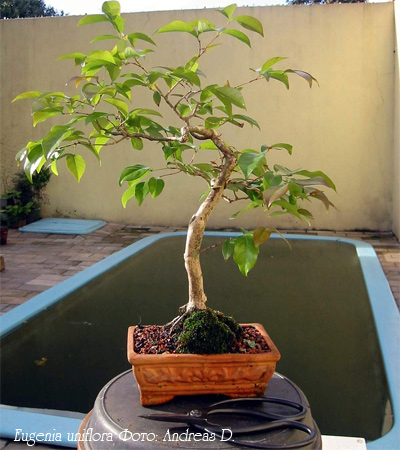 Eugenia is one of the best plants for forming bonsai (pre-bonsai).
Fertilizer: from March to August, Eugene, planted in a regular pot, is fed with complex fertilizer for deciduous plants, every two weeks, using in half a dose. If the plant is in a small area, then feeding is carried out every two weeks during a period of intensive growth, and every 4-5 weeks in winter, a special fertilizer for bonsai is used.
Air humidity: Regular spraying in the hot season - 2-3 times a day with distilled (or boiled) water. You can place the pot on a wide tray with wet pebbles. If there are no hot batteries nearby and the weather is not too hot (above 30), then it is not necessary to spray, Eugenia's leaves are similar to ficus leaves, dense enough, leathery to put up with some dry air. Ideally, they prefer 40-50% humidity.
Transplantation: adult plants are traditionally carried out every two years, young annually. But if the soil began to be salted (white or reddish coating on the surface), it is necessary to transplant the plant or replace the top layer of soil in the pot. The soil should be slightly acidic pH 5.5-6.5. Approximate composition: 1 part of sod, 1 part of sheet earth, 1 part of humus, 1 part of sand. Eugenia loves slightly acidic soil, does not tolerate lime in the soil. When transplanting bonsai or potensai, roots are often pruned. But with pruning the root system, Eugene needs to be careful, some species tolerate pruning roots very badly, freeze in growth, shed leaves. Therefore, perform this procedure only when necessary. After transplanting, and even more so pruning the roots, it is advisable to put the plant for the first time (5-6 days) in a shaded place. Never transplant freshly purchased plants that have been rearranged from cool wintering into a room, or vice versa, those that are going to be rearranged. Do not transplant on hot days in the summer.
Personal experience, burg: my soil for Eugene is simple and versatile, consists of only two components: coconut briquette soaked in 5 liters of water in half (in volume) with perlite (perlite is very desirable to wash off the dust-like fraction in a fine-mesh colander under a stream of water). Mixing 5 liters of these components, you get the same 5 liters, but already an ideal substrate. It has no nutrients, is a rational compromise between ordinary soil and hydroponics, therefore, it requires a systematic application of a solution of liquid fertilizers. But everything in it grows perfectly and cannot be "bays," since the mixture is quite stable for a long time (2-3 years).
Pruning: Eugenia can be pruned in spring and summer (March to October), shortening shoots by 1-2 pairs of leaves. If possible, on thick twigs, treat the sections with garden var. Eugenie can be shaped in almost any bonsai style. You can also form the direction of the branches with wire, having previously protected the bark on them from damage. The branches bend well, but the growth rate usually does not allow keeping the wire on them for more than 3 months.
Reproduction: cuttings, seeds (germination is 3-4 weeks) and air extraction. In spring, cuttings are cut about 10 cm long and rooted in water or moist vermiculite.