Pontederian family. Homeland Brazil.
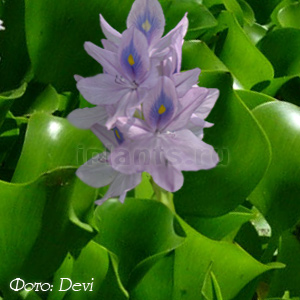
This plant is especially beautiful during flowering, which not everyone can achieve at home. The stems of eichornia are short, and filiform dark purple pubescent roots. On the stem are rosettes of oval leaves. Leaf petioles are bubbly, filled with air and provide free swimming of the plant on the surface of the water (often they are mistaken for bulbs. Flowers appear in summer, on a peduncle coming from the center of the rosette of leaves. The flowers themselves are pink-lilac and there is a dark patch on one of the petals. Flowers last only one day. Then the peduncle goes under water.
How to care for Eichornia
Temperature: eichornia is thermophilic, it needs about 25-27 ° C, at least 22 ° C, and during flowering 28-29 ° C. Eichornia does not tolerate draft and sudden temperature changes, so the glass covering the aquarium should lie tightly, closing from the draft if the room is ventilated. But the rest of the time, fresh air is required. For many, this plant dies in aquariums precisely because the lid lies on top and the ventilation is too small.
Lighting: the intensity of photosynthesis is higher in eichornia than in underwater plants, it is photophilous, and shading is not required. In autumn and winter, artificial lighting may be needed, it is best to use fluorescent lamps, as in a regular fish tank. However, daylight hours lasting more than 14 hours will lead to rapid overgrowth of plants and will have to thin out the plantation more often.
Reproduction: vegetative, developing new plants on lateral shoots. In the homeland, eichornia also propagates by seeds.
To grow large specimens, fertilizers for ordinary indoor plants or fertilizers for aquarium plants are periodically added to water for water hyacinth. If you grow eichornia in a regular fish tank, then it will most likely grind, and then simply rot. Eichornia can only be grown in open aquariums or ponds.
When keeping plants in a separate container, you need to choose a low but spacious aquarium, or a wide vase (in the form of a low basin). As a substrate, sand with peat additives is used, garden land or pure peat can be used.
Roots are dropped into the substrate, the thickenings of the petioles raise the leaves in free swimming. I.e. so much water is poured that the rising leaves are not covered with water. Under natural conditions, water hyacinth floats freely on the surface of water bodies, but when the water dries, eichornia takes root in the silt.
