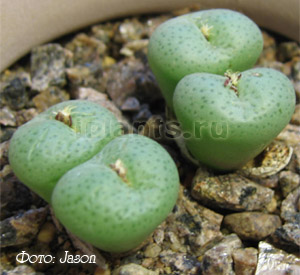
Aisoonic family. Homeland South Africa. In nature, these are about 270 species of leaf succulents growing in groups in arid areas. A characteristic feature of most conophytums is that their dormancy period occurs from late winter to mid-summer, or from spring and will last until early autumn. Conophytums are small plants, typically forming dense but slow-growing colonies. A separate plant consists of a pair of fused leaves. Moreover, the degree of leaf intergrowth depends on the species. The most common species are:
- Conophytum bilobum - has a slightly flattened heart-shaped "body," bluish-green in color, about 2.5 cm in diameter. The flowers are yellow, up to 3 cm in diameter, appear in late August - September.
- Conofitum whitish Conophytum albescens - has a laterally flattened body, obovate, formed by fused grayish-green leaves. The "body" is about 2.5-3 cm in diameter. The leaves are covered with minute whitish pubescence and have a dotted pattern on their upper surface. The flowers are yellow.
- Conophytum obconellum - has a reverse conical shape "body," about 2 cm in diameter. The leaves are covered with fine pubescence and have a dotted pattern on their upper surface. The flowers are yellow.
- Conophytum nanum Conophytum nanum - has a spherical body, only about 7 mm in diameter. The leaves are greyish-green. Flowers up to 1 cm in diameter, white, and the ends of the petals are reddish.
- Frederick's conophytum Conophytum fridrichae - has a heart-shaped body, about 2.5 cm tall. The leaves are almost completely fused, grayish-green with a translucent surface and dark stains - spots on the upper side. Flowers up to 1 cm in diameter, white, and the ends of the petals are reddish.
- Pearson's conophytum Conophytum pearsonii - has a spherical body, up to 1.5 cm tall. The leaves are practically fused, blue-green to yellowish-green in color. Flowers up to 2 cm in diameter, purple-pink.
Conofitum - care and cultivation
Temperature: moderate throughout. In summer, it is better to keep outdoors or in a well-ventilated room. In winter, the rest period is at a temperature of 13-14 ° C, not less than 6 ° C, not more than 15 ° C, with dry content.
Lighting: Conofitum requires full sunlight, but sun training must be gradual to prevent the plant from getting burned.
Watering: moderate during growing season. Watered very carefully, the roots quickly rot from excess water, so between watering succulents should stand dry. During the rest period, watering is stopped altogether.
Irrigation requirements depend on the type of conophytum and the timing of its dormant period. Generally, species with larger long leaves have a dormant period from late winter to early summer, while plants are small with globular leaves from mid summer to late autumn. From the beginning of the dormant period, watering is reduced, while the leaves of the conophytum begin to gradually wrinkle and their skin thins. Watering at this time is stopped altogether. Since the completely aerial part of the plant does not die - new leaves are formed inside the old leaves, watering at this time can lead to decay and death of the plant. They begin to water the conophytum only when the old leaves completely shrink and the skin becomes very thin.
Feeding: Konofituma is needed only if it was not transplanted. Fertilizer is taken in a dose two times less than that recommended by the manufacturer, and applied with water for irrigation 1 once a month. For feeding, special fertilizers for cacti or succulents (and with a low nitrogen content) are used.
Air humidity: tolerates dry air well, does not need spraying.
Transplantation: Conophytums prefer cramped pots, so transplantation is usually carried out after 2-3 years. Tanks for planting should be wide and not deep with a high drainage layer. The soil is the 1 part of the sheet earth, the 1 part of the river sand, the 1/2 part of the clay. You can use a purchased soil mixture for succulent plants. After transplantation, in order to avoid rot, the roots are watered only after 2 weeks.
Reproduction: after young leaves begin to grow, a separate "body" of conophytum is cut off with a sharp knife. The cut is sprinkled with phytohormone powder and dried for 2 days. Then they are placed on a dry soil surface in a cooked pot and watered no earlier than after 3 weeks, when young roots have already appeared.
