Gesnerium family. The genus has about two hundred species, perennial epiphytic grasses or shrubs. Homeland - tropical areas of America. Some common species have become material for beautiful hybrids and varieties.
The glorious Columnea gloriosa is an epiphytic semiampelous plant native to Costa Rica and Panama. Shoots are fleshy, gradually woody, up to 60-70 cm long. Ovoid leaves about 2 cm long, green or with a reddish tint, covered with short hairs, sit on the stems very tightly to each other. The flowers are axillary, tubular, charlach-red in color, with yellow spots at the base.
Columney linear Columnea linearis is a shrub all from the same Costa Rica. Stems about 50 cm long, thick. Leaves are lanceolate, narrow, up to 10 cm long, and 1 cm wide, dark green, on very short petioles. The flowers are single, axillary, two-lipped, up to 6 cm long, bright pink, covered with white short hairs.
Columney pubescent "Columnea hirta" is an epiphytic semi-ampellous plant native to Costa Rica and Panama. With slightly branching reddish shoots, up to 80-90 cm long, covered with short hairs. The leaves are opposite, on short petioles, fleshy, velvety-green, ovoid, also covered with short hairs. The flowers are orange-red, axillary, with a narrow tube, about 3-7 cm long. The cultivar 'Light Prince' has cream spots on the leaves.
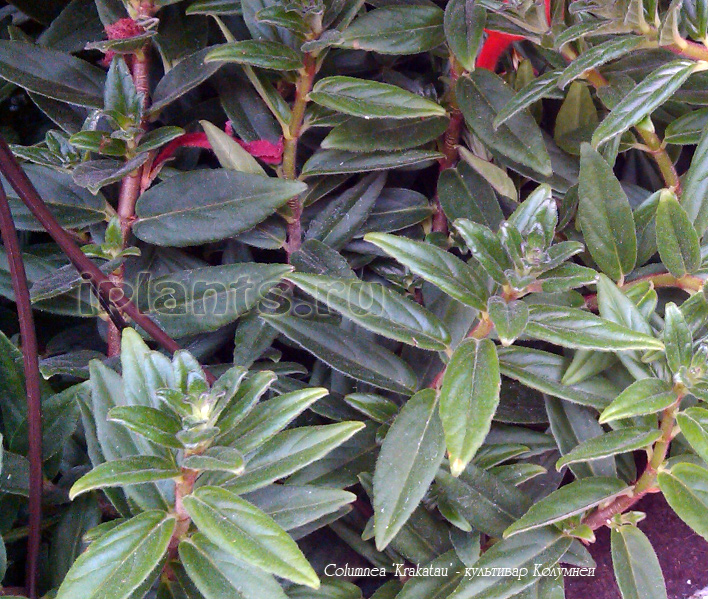


Caring for a columnist
Temperature: In summer, normal, about 20-25 ° C, if it is very hot (above 26 ° C, it is better to rearrange the plant to a cooler place). In winter, a cooler content at 18-19 ° C, at least 16 ° C, preferably not higher than 20-21 ° C, is preferable. Despite the fact that the columnar is a heat-loving plant, the winter dormant period for a month or two, with a cool content, is necessary for laying flower buds.
Lighting: Columney loves bright diffused light, with shading from direct sunlight in spring and summer during the hottest part of the day from 11 to 16 hours. In winter, from September to February, the lighting should also be very good. In winter, the sun stands low above the horizon, so even direct sun on the south window is louder, not scary. But if the room is warm and there is not enough natural light, the columnar shoots begin to gradually stretch and bare, so you need to provide additional lighting with fluorescent lamps.
Watering: In summer, water is plentiful, after the top layer of the earth dries (about the top third of the pot). Since autumn, watering is reduced, watered with warm water, when almost everything in the pot dries up. But complete drying of the ground is not allowed. Columney is more demanding on air humidity than soil, so it is easier to endure drying the ground than excessive watering. Excessive watering when kept in cool conditions and/or insufficient lighting is especially bad for columneas.

Air humidity: Optimal 60%, not lower than 50%, such humidity is natural in our apartments from the moment the heating is turned off in the spring, and throughout the summer, except for very hot, dry days. But in autumn and winter, air humidity, as a rule, is not enough. Not all columns can be sprayed, but only those with rare hairs, or completely bare leaves (most columns have pubescence). In addition, spraying briefly humidifies the air. Therefore, plants must be placed over wide trays of water, you can use an air humidifier, or fence off the windowsill with plants from the battery, plexiglass sheet or film.
Fertilizers: Regularly from April to August, they are fed with a solution of complex fertilizers for flowering indoor plants at a dose two times less than for ordinary plants. Feeding is carried out every two weeks. Fertilizers for senpoli in the recommended dosage are well suited.
Transplant: Annually in spring usually in hanging baskets or planters. In this case, the pot should not be too large, otherwise the roots can rot if irrigation is disturbed. In addition, columnes bloom better in a cramped pot. The soil should be light, nutritious, very loose - 2 part leaf, 1 part humus, 1/2 part river sand, 1/2 part vermiculite, 1/2 part coconut substrate (or coconut chips). You can also add fern roots and pieces of charcoal to the soil. Most columnar epiphytes or semi-epiphytes, it is very important for such plants that the earth dries quickly and transmits air well. It is also important that the soil has a slightly acidic reaction.
Reproduction of columnar
Stem cuttings in spring and summer. Cuttings 5-10 cm long are cut from an adult plant. They are rooted either in water (some species, easily form roots, others very slowly), or in soil consisting of the 1 part of the leaf (peat) land and the 1 part of the sand. You can root columnar cuttings in a glass with wet sphagnum moss.
You need to root the cuttings in small cups (about 8 cm in diameter). And necessarily in conditions of high humidity. I.e. you need to cover the pot with a can, bag or cap (cut off the bottom from 5-6 liters of a transparent plastic bottle), but be sure to leave a gap for airing.
You will learn that the stalk is rooted in the ground when a new young leaf grows on it. When the cuttings have grown enough, they can be transferred to large pots, into the ground for adult plants.
Growing problems
In general, columnar unpretentious plants, if you choose the right soil, provide good diffused lighting, protect batteries from hot air in winter, then the plant will delight with green foliage and lush flowering.
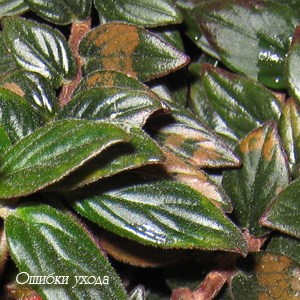
But sometimes plants get sick and wither. One of the signs of disorders in care is the appearance of brown spots on the leaves. This can occur for various reasons, the most common: excessive watering, too abundant spraying of leaves (especially with cold water), cold draft, fertilizer overfeeding, sunburn.
The composition of the land also affects the correctness of irrigation. If you plant a plant in too dense soil, the earth dries up for a long time, which is unacceptable for a columnist. This is an epiphyte plant, its roots are thin, shallow, love frequent moisturization, but quick drying.
Worst of all, when they try to compensate for insufficient humidity with more frequent irrigation. From this, the roots partially rot, the leaves brown and fall off.
In winter, the column can only be watered with warm water when its temperature is 3-4 degrees higher than the air temperature. By the way, it is better to use soft, boiled or filtered water for irrigation.
Of the pests, mites and mealybugs can most often threaten. If suddenly the leaves of the plant began to dry, the stems were exposed, take a magnifying glass and carefully examine the shoots. The mealy worm can also be seen with the naked eye - white shaggy lumps in the axils of the leaves. Fight with insecticides (actellic, actara, confidor).
It is more difficult to detect a tick - first of all, look at the leaves in the lumen, evidence of arthropod damage is point punctures and yellow (and not brown) spots of irregular shape. It is necessary to fight with the help of acaricides (Apollo, Vermitek, Nissoran).