Family of madder. Homeland Africa and Asia. There are about 40 species in nature.
- Arabian coffee or Arabica coffee Coffea arabica is an evergreen tree that reaches 4 m in height in nature. Although a dwarf variety is more common in culture, growing only about 1 m in height. The coffee tree branches well, the leaves are opposite-located, oblong, pointed at the end and wavy along the edge, up to 15 cm long. The surface of the leaf is dark green, leathery. The flowers are axillary, fragrant, collected 5-6 pieces, on short pedicels. Corolla of a five-petalled flower, white. Fruits - berries with 2-3 seeds, appear only on adult plants. Flowering in April - May.


Coffee tree is considered by many to be an undemanding plant, but this is only if the conditions of maintenance are correctly observed. At home, coffee grows quickly, reaches the ceiling (height of 2.5 m) in 8-9 years with sufficient illumination. It is one of the few tropical fruit trees that is easy to grow in an apartment, i.e. in warm conditions all year round.
Coffee tree care
Temperature: Mild in summer, doesn't like extreme heat, so don't leave on a glazed balcony on sunny days. In winter, it is ideal within 14-15 ° C, but not lower than 12 ° C, but if there is no possibility of cool wintering, coffee will normally survive the winter, if it does not stand next to a hot battery and it has enough light.
Lighting: bright diffused light from March to July, shading from direct sunlight is required only in the hottest hours of the day (from 11 to 15 hours). From autumn to the end of winter, at air temperatures above 22 ° C, additional illumination may be required if the pot is far from the window, moreover, from October to the end of January in central Russia, the sun is not aggressive and shading is not required at all. If necessary, you can illuminate the coffee tree with LED or fluorescent lamps.
Watering: plentiful in summer, so that the soil inside the pot is slightly moist, and has time to dry in the upper half of the pot for the next watering. In winter, moderate, but taking into account the temperature indoors, if wintering is cool, after drying the soil before watering, wait a few more days (if about 18-20 ° C - a week, if below 16 ° C for about 2-3 weeks). Avoid excessive dampness and overdrying of the substrate - coffee is equally bad for both. To avoid waterlogging, pay attention to the porosity of the soil. If the water in your area is hard, then use water filtered by household filters or boiled for irrigation.
Top dressing: during the growth period from April to September every two weeks with complex fertilizers for indoor plants. It is correct during the growing season, leaf growth, to start feeding with fertilizers containing a high proportion of nitrogen (Ideal, Uniflor growth, Pocon for deciduous, etc.) or well-diluted organic matter. Carry out 2-3 top dressing, with an interval of two weeks. Then switch to fertilizers with a high proportion of potassium and phosphorus. This is potassium nitrate, potassium monophosphate, etc. Coffee tree is very sensitive to a lack of potassium - when deficient, it manifests itself in browning and drying out of the tips and edges of the leaves, the so-called edge burn. The need for potassium in flowering and fruiting coffee trees is especially high. If chlorosis appears on the leaves (veins are green, and yellowness between them), the reason may be a lack of iron, which needs to be replenished by spraying iron-containing drugs on the sheet.
Humidity: The coffee tree requires high humidity, spray it with warm, soft water, distilled (so that there are no stains on the leaves) or turn on the humidifier on hot days in summer. In winter, protect batteries from hot dry air in every possible way. If it is not possible to rearrange the coffee tree in a cool room, hang the batteries with wet sheets, put pallets with wet gravel or moss. But no need to spread raw moss on the surface of the pot, only outside it! Otherwise, the closed moist soil turns sour, the roots do not breathe, rot.
Transplantation: annually in the spring young plants, old - in 2-3 years, but with the annual replacement of the upper layer of the earth in a pot. Coffee requires a slightly acidic soil reaction optimally 5.5-6, but not more. Soil is prepared from 2 parts of sheet earth, 1 part of greenhouse earth, 1 part of humus, 1 part of fine gravel (crumbs 2-3 mm) and 1 part of pine bark. You can add a handful of vermiculite. Good drainage is necessary, about 2-3 cm to the bottom of the pot.
Reproduction: by seeds and semi-lignified cuttings in spring.
Coffee tree seeds quickly lose their germination, so they are sown immediately after ripening. Ripened fruits are removed, cut and seeds are cleaned from pulp, then washed in warm water. A substrate of peat, leaf earth and sand is poured into the plates, and the seeds are laid out on a flat side on the surface, slightly crushing, but not sprinkling with earth. Watered or sprayed from a spray bottle with warm, soft water and placed in a plastic bag. Twice a day, the seeds are ventilated for half an hour to avoid excessive dampness and mold. Seeds germinate within 2 months, at a temperature of about 20 ° C and slightly higher, so soil heating is possible. After two pairs of leaves are formed, the coffee is transplanted into separate pots. Young plants begin to bear fruit only for 3-4 years, when they reach fertile sizes - about 150 cm tall.
Peculiarities of growing a coffee tree
Here are some tips from flower growers who know about the coffee tree at home firsthand.
Jakonya: I will tell you the original way to germinate coffee from seeds. Coffee seeds (fresh, green only) are thrown into a glass of water. This glass should be placed under the lamp, in a warm place (the water should always be warm). Change water daily. When the roots are laid, catch the seeds and plant them in the ground. So coffee grows much better than just sowing in the ground.

At the coffee tree, the thin bark peels off. The tree itself feels excellent, drinks like a horse, starts new shoots, honestly branches without pruning. But maybe what I'm not doing, or what is he missing?
And how to make coffee bear fruit?
Alex: Coffee just molts - the old spent bark moves away, under it should be young. You have a completely healthy plant, start feeding with mixtures of organic and mineral fertilizers. For example, you can feed Agricola for blooming rooms.
Nicolas: If you want coffee to bloom and bear fruit, pour 1-2 cm of horn shavings over the drainage into the pot. In addition, the top of the roots is also mulched with horn shavings by 5-10 mm. Water the coffee tree only with soft water, be sure to be warm.
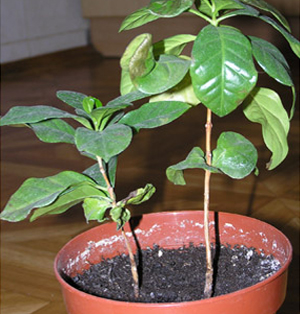
Why is the coffee trunk exposed and how to cut off coffee correctly?
Alex: they live leaflets for 2-3 years, then begin to die. For trimming, step back 2-3mm from a couple of leaves where you have planned to trim the branch, and cut it off with a pruner or sharp knife. Very soon, two twigs will appear from the extreme leaves, so you can achieve a very thick and beautiful crown.
Nicolas: to form a coffee tree, proceed according to the scheme: pinch the tip of the shoot on the fourth pair of leaves, then on the third, and then on the second, that's all. This scheme is advisable, because the coffee branch grows to almost one and a half meters, and in the third year it changes the old foliage.
Jekky: I also have long, bare trunks, although the leaves were not yet two years old when they fell. It is believed that the reason is that there is no change of seasons in the room, because coffee does not have time to be covered with bark. There should be a slight decrease in temperature, as recommended above to 15-16 ° C. This is especially true for Dutch (greenhouse) coffee trees. Those grown at home from seeds are more adapted to home conditions.
Hovea: don't be discouraged by the bare trunk of coffee. I was in the Ecuadorian jungle and saw coffee in the wild. The same bare trunk, and even the leaves are eaten by parasites! I was even somewhat shocked by such a nondescript look of real coffee! I also have a coffee tree, he is 4 years old, the trunk also exposed over time. Last year it bloomed and gave several fruits. And now I have awakened several kidneys on a bare trunk. In general, we are growing interestingly!
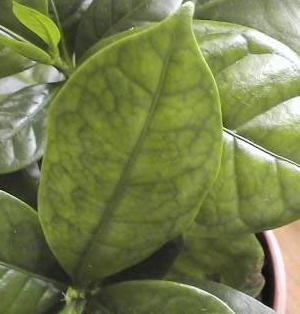
At the coffee tree, new leaves, growing, acquire chlorosis (light-colored between the veins). It stands in a well-lit place. What is he missing?
Alex: Coffee leaves are unhealthy and this is associated with a violation of the acidity of the soil. The soil is too acidic and is not absorbed or passes into hard-to-reach forms such as iron and manganese. Now feed the coffee with an ash extract. Preparation of an extract from ash: take a tablespoon of ash per liter of water, stir and let it brew for a couple of days, drain from the precipitate and water the plant.
If coffee yellows lower, older leaves, then, most likely, there is a planned replacement of leaves. The duration of coffee leaves, as well as in citrus fruits, is 2-3 years, on young plants this period is shorter. Leaflets, before falling, give all their accumulated nutrients to the next generation leaflets, so they turn yellow.
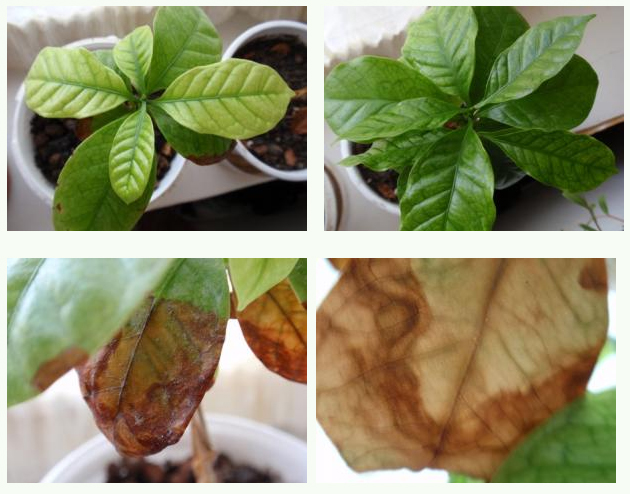
Coffee leaves are too light in color. I try to maintain soil moisture, spray, water warm water, feed fertilizer for roses, after 2 weeks alternate root and spraying leaves. They stand on the southern shaded, if hot, window, planted in the ground for lemons. It used to be very bad - the leaves "rusted" and dried. Now they began to grow, but for some reason very bright.
Natalia Matyushevskaya: Lightening of leaves in coffee can be observed when the acidity of the soil is unsuitable. I recommend periodically watering with slightly acidified water. I usually add lemon juice - 2/3 drops per liter. But you can either citric acid (a few grains per liter) or apple cider vinegar (half a teaspoon per liter of water). Also, a similar picture occurs due to the lack of assimilable iron - try the old "grandfather" way - a rusty nail in the ground. I have not used any chelates for a long time, and there are no problems with chlorosis.
irina-bahus: chlorosis on coffee leaves. Try spraying with iron chelate, watch the reaction to it. And add citric acid to the water for irrigation (a little). In an alkaline environment, iron in the desired form is not absorbed.