
Cootra family, flipper subfamily. Homeland Asia, Africa, Australia and the Pacific Islands. In nature, there are from 160 to 200 species (according to various sources). The name ceropegia comes from the Greek keros - wax and pege - spring, fountain (from the shape of a flower), this name was assigned by Karl Linnaeus in 1753. Ceropegia is a relative of the well-known hoya.
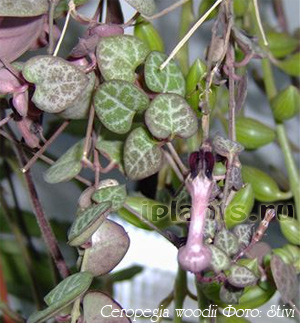
- The most common species is Wood's Ceropegia "Ceropegia woodii." It is a herbaceous plant that has a tuberous rhizome. The stems are thin, filiform, creeping, low-branched. The leaves are opposite, on short petioles, round-heart-shaped, fleshy, about 2.5 cm in diameter. The surface of the leaf is bare, above with a silver marble pattern on a green background, below with a purple tint. Ceropegia forms a small-flowered umbrella-shaped inflorescence. The corolla of the flower is about 2.5-3 cm long, fused, pitcher-like, swollen at the base, purple-pink in color with dark purple, terry petals along the edge.
Care for Ceropegia
Temperature: moderate in summer, preferably not higher than 28 ° C. In winter, cool, preferably not higher than 17 ° C, at least 10 ° C. Not to say that ceropegia died in winter from high temperatures, but the shoots are strongly stretched and exposed in the lower part. In this case, it is better to cut off all the tops of the shoots in the spring and re-root them.
Lighting: bright sunlight, shading on the south window during the midday hours. With a lack of color, the leaves of the plant become even smaller, shoots are rare and slightly leafy, and you may not wait for flowering.
Watering: Moderate from spring to autumn. The top layer of soil should dry well before the next irrigation. In winter, watering is rare only when the soil dries almost completely (depends on temperature). Watering water should be soft and persistent. Ceropegia easily tolerates overdrying, but from waterlogging, especially in cool weather, tubers can rot. This must be taken into account if the plant stands on the balcony in summer - in rainy weather, with a night drop in temperature, the soil dries much more slowly. And it is better to water in the morning.
Fertilizer: from May to August, fed once a month with liquid fertilizer for indoor succulent plants. The dose of fertilizer is taken half the recommended by the manufacturer - these are very minor top dressing, although you can do without them.
Air humidity: Ceropegia is undemanding to humidity, does not need spraying.
Transplant: annually or every two years, in spring. The soil needs a loose, coarse structure - the 1 part of the sod, the 1 part of the sheet earth and 1 part of the sand, pH 5-6. Good drainage must be done, and not only at the bottom of the pot - add fine (2-3 mm) expanded clay or gravel crumb directly to the earthen mixture. When transplanting, the tubers are buried in the ground.
Reproduction of Ceropegia
Propagate ceropegia with stem cuttings, axillary nodules and branches. Cuttings quite easily root in water in the warm season, it is better to put them on rooting in March-June. It is worth planting 4-5 rooted cuttings in one pot.
Small nodules can be found in the axils of the leaves at the wood ceropegia. Thus, in nature it multiplies - ceropegia grows on the rocks. Shoots spread over the surface and where there is fertile soil, nodules germinate, form roots and give new shoots. After a while, a whole carpet grows out of one plant.