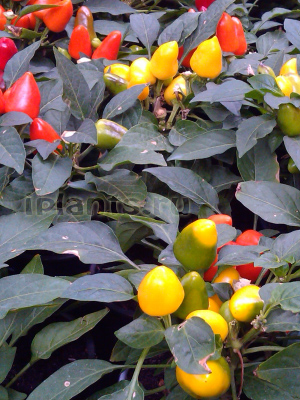
Nightshade family. Homeland - Central and South America. There are about 50 species of representatives of this genus in nature.
Types of peppers
The following species are grown in pots as house peppers:
- Capsicum annuum annual (vegetable) capsicum
- Cayenne Capsicum frutescens
- Chinese pepper or Habanero Capsicum chinense
- Capsicum pubescens fluffy pepper (or rockoto pepper)
- Capsicum baccatum berry pepper
All of these species belong to the Chilean pepper group, any of them can be called green pepper or chili pepper. The birthplace of each species is the tropical areas of South and Central America. Various species of green peppers have a similar structure - all of them are shrubs with a non-lignified stem (except for berry peppers - it can grow as a tree), in nature they reach 1 m in height or more. The leaves are alternately located, more often sitting on short petioles, lanceolate, narrowed at the end. The flowers are solitary axillary. Corolla of flower 5-7 petal. Fruits are hollow multi-seeded. Next are specific differences specific to a particular species and variety.
You also need to know that there is no botanical name like Chili Pepper or Bitter Pepper. These are groups that unite peppers in taste. So bitter pepper includes some varieties of Capsicum annuum and many varieties of Capsicum frutescens. By the way, you cannot grow bitter and sweet peppers on the same windowsill - they can pollinate themselves (just shake a pot of pepper), and give out fruits of not quite pleasant taste.
Capsicum annuum capsicum
We know it under the name vegetable pepper, paprika or Bulgarian pepper. Many varieties are called sweet peppers, but there are varieties that are quite spicy and bittersweet. The shape of the fruits is cone-shaped, in various variations - pot-bellied and elongated, even and bent, etc. The colors of the fruits are also very diverse: bright red, yellow, orange, purple, green, light green.
Varieties of annual capsicum for growing in pots:
- Tepin Tepin
- California wonder California wonder
- Yolo Wonder Yolo Wonder
- Redskin redskin
- Diana Diana
- Siberian prince
- Quintisho quintishos
- Iko Iko Iko Iko
- Cherry bomb Cherry bomb
- Sweet Mini Bell Baby Yellow
These varieties differ in average or compact growth from 35 to 60 cm. But in principle, you can grow completely any varieties in pots. It all depends on the width of the windowsill - large bushes take up a lot of space, and growing peppers in a room even with additional light is almost unrealistic - this is a very photophilous culture .
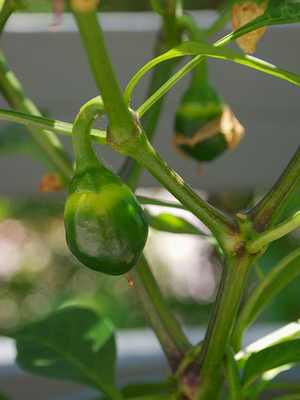 Pepper one-year-old "Cherry Bomb"
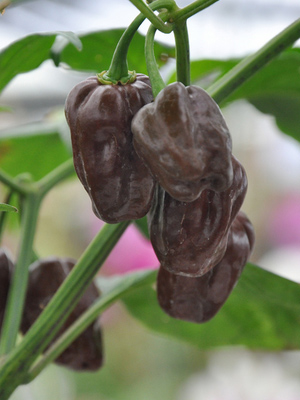 Chinese pepper 'Habanero Chocolate'
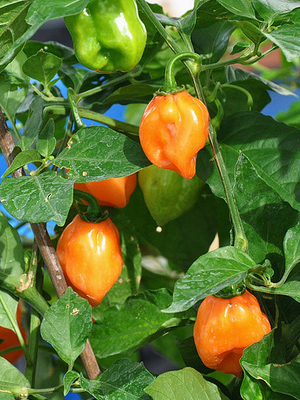 Chinese pepper 'Habanero Orange'
Chinese Capsicum chinense pepper or Habanero pepper
Pepper is native to Central America (Chile), from the Caribbean islands. The plants are bushy, usually with stiff, erect stems, large, thin and wrinkled green leaves. The flowers are usually small and white, with five petals of 2-6 flowers in a knot. The size and shape of the peppers is very diverse - from small and rounded to elongated pods, sometimes in the shape of a flashlight. Capsicum Chinese the most burning (hot) pepper, when grown in a pot, has a very decorative appearance. But you need to know that these plants are relatively slow in growth with a longer growing season compared to many other species. In addition, Chinese pepper seeds take longer to germinate and fruits take longer to mature, especially in temperate climates. The total time from sowing to harvesting is about 80 to 120 days. Varieties are suitable for home cultivation:
- Santa Lucia Saint Lucia
- Devil's Tongue
- Devil's Yellow Devil's Yellow
- Habanero Habanero cultivar group
Cayenne Capsicum frutescens
This is a sharp variety of chili pepper - there are annuals or short-lived perennials (decorativeness maximum 2-3 years). Fruits are often erect, small, conical, protruding like candles 1.5-2 cm long. Coloring from pale yellow to bright red. Selection is underway to improve decorative qualities. This pepper species has the remarkable Black Pearl variety - it is an ornamental leafy plant with very dark purple leaves. The fruits are red and sharp when ripe. You may also be interested in other varieties:
- Tabasco Tabasco
- Piri Piri piri or African Bird Eye or African Devil
- Limo Limo
- Bombilla Bombillito
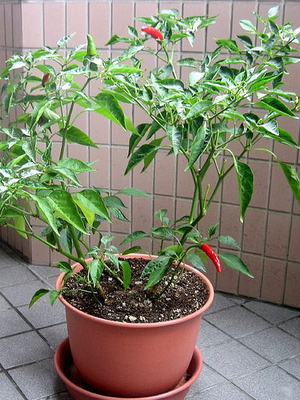 Cayenne pepper
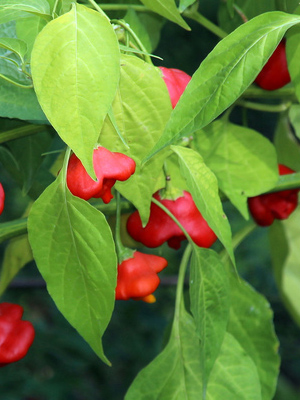 "Bishop's Crown" berry pepper
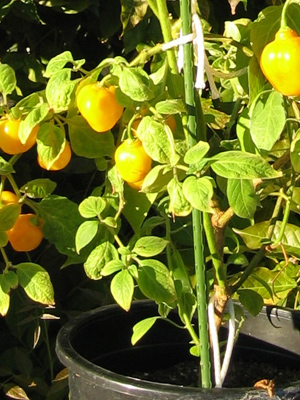 Fluffy Rokoto pepper
Capsicum pubescens fluffy pepper
In this type of pepper, the entire aerial part: stems, leaves, petioles, peduncles and flowers are covered with dense light green pubescence, and hairs on the leaves even from the upper side. The leaves are ovoid, up to 5-12 cm long, 2.5-4 cm wide, tapering at the top, and the base is wedge-shaped. Flowers with a purple corolla. A very notable feature of this species is its ability to withstand cooler temperatures than other plant pepper species. And besides, this species is almost the longest-lived - in nature up to 15 years! And by the way, there is an ampel variation of fluffy pepper. Fluffy pepper fruits are used fresh (salsa, salads), added to minced meat, dried as a seasoning.
- For the sake of fruits in pots, you can grow a group of varieties of Rocoto peppers
Capsicum baccatum berry pepper
A wonderful houseplant - this is who can be grown calmly for several years in a pot! In nature, it reaches 1.5 m in height, at home about 80 cm. It tolerates pruning well. It is a spreading, small-leaved shrub. On sale you can find seeds of the Bishop's Crown variety Bishop's Crown - it forms small fruits not cone-shaped, but similar to the bishop's headdress (in our opinion, they look more like scallops). They have a sweet and light spicy taste. When grown in greenhouses, the yield can reach 50 peppers from a bush, when grown in a pot, a maximum of 20 peppers, but this is also an excellent result! Other varieties are more productive, with up to 50 peppers on the sunny window:
- Lemon Drop Lemon Lollipop
- Cristal Blanco White Crystal
Pepper care
Attention: peppers - perennial plants, can be grown for several years, subject to the correct agricultural technology. Let you not be confused by the name of annuum vegetable pepper - annual (annual), it does not reflect reality - this type of pepper is also perennial. In nature, shrubs live for years. But the decorative value decreases every year due to the strong exhaustion from the stormy fertility of this vegetable, and most importantly - at home there is no way to provide a cool wintering and a lot of light. Since from the point of view of the florist, the aesthetic beauty of the plant in the pot is very important, it is easier to grow new plants from seeds every year or two.
Care for peppers in pots is aimed at getting the most decorative look, and it is good when it is covered with fruits that can be consumed in food. Therefore, the main thing that we need to know is that pepper - as a tropical culture loves heat, light, good watering and adequate nutrition during growth. If you want already grown pepper in a pot, you can buy it on the OBI network or from grandmothers selling seedlings in the spring. During the flowering of peppers, it is required to periodically shake the bushes - this is how the fruits are tied better.
If your peppers continue to bear fruit in the fall, you need to adjust the number of fruits, otherwise the plant may not pull out such a burden - if the peppers are large-fruited varieties, leave no more than one fruit on the bush, if small-fruited - a maximum of three. In hot and bitter chili peppers, you can also eat green peppers.
Temperature
The optimal temperature for growth is 18-24 ° С, at night it is cooler - up to 15-18 ° С. The room should be well ventilated. You can keep capsicum all summer on the balcony or in the garden, and in the fall you can bring it into the apartment, where the fruits will ripen. If in winter you do not have enough light, there is no way to make a good additional light, lowering the temperature to 15-16 ° C is simply necessary. Watering is rare, just so that the soil does not dry out at all.
Lighting
Full sunlight, at least 4 hours a day of direct sun. South and west windows grow well.
Watering
Peppers need quite abundant watering - the soil should be moist all the time, not dry out in the depths of the pot, but dry out in the upper third of the soil for the next watering. After copious watering, it is advisable to loosen the top layer of soil .
Humidity: Pepper is sprayed periodically (once a day) with clean (filtered or boiled) water.
Fertilizing
A month after transplantation, feeding is required. It is better to use special fertilizers for vegetables, in which there is a greater proportion of phosphorus than nitrogen, which is necessary for better fruiting, for example:
- Dunamis for NPK vegetables: 2.5% -2% -1%, pH% 7 - 7.5
- Vegetable garden fertilizer NPK: 5% -6.5% -6.5%, Ca - 2%; Mg - 1%; Fe – 0,16%; S – 0,70%; В - 0.09%; Cu - 0.01%; Zn - 0.01%; Humates not less than 1%
- joy humic Fertilizer for Tomatoes, Peppers, Eggplants - liquid
- Fertica Suite (Floral)
- Compound mineral: take 1 g of superphosphate and 1 g of potassium salt per 1 liter of water
Feeding should be carried out 1 once every 10 days in spring and summer, in winter 1 once a month. We do not feed other indoor plants in winter, but peppers need it (provided that they are not cut and well lit).
Flight connections
Indoor peppers can be grown in the same store soils that are sold for seedlings of vegetables and peppers. For example, the soil of Russian Fields "Bioperezhnoy. Tomato and Pepper" (with the addition of biohumus), universal soil "Terra Vita," universal peat soil "Ambulance," etc.
You can also take just garden land and add the necessary fertilizers to it, for example, in the joy granules "Fertilizer for Tomatoes, Peppers, Eggplants" or "Buoy fertilizers for vegetables" - they are applied dry to the soil, not by eye, but it is better to weigh them on electronic kitchen scales. Mix the soil thoroughly.
By the way, peppers are plants susceptible to many diseases of vegetable crops - phytophthora, vilta, tobacco mosaic virus. If you do not want to ruin your labors, be sure to sterilize the earth, for example, in the oven (30 minutes at 200 ° C).
The dimensions of the pot for adult pepper are about 25 cm in diameter. Before that, plant and transfer the peppers to any suitable container according to the size of the root system.
Seed peppers
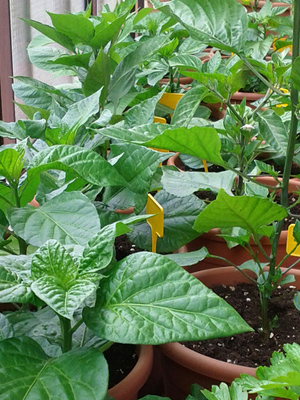
Seed germination is generally good - 80-90%. Pre-soak the seeds in a faint pink solution of manganese. If the seeds surfaced during soaking, they are not viable, you can throw them out.
Seeds of capsicum are sown in spring or at the end of winter in wide plates, in a mixture of peat and leafy earth, sealing holes for water runoff to a depth of 1 cm. Drainage is not necessary - they do not need to grow there for a long time, and therefore a layer of soil is enough for 7-10 cm. When the first pair of real leaves grows up in seedlings, they need to be picked in separate pots. Burial - up to cotyledons.
More willingly and plentiful, capsicum blooms and bears fruit if the pot is not large for it, but exactly along the root or slightly cramped. It is more correct, if necessary, to transfer them (without disturbing the roots) as they grow into a larger pot.
The most important thing in caring for pepper seedlings is to provide maximum light. If the seedlings are pulled, the plants will initially be weak, you will not get either decorativeness or yield. Therefore, as soon as seedlings appear, and the days are cloudy, turn on the lamps. These can be special phytolamps, simple chandeliers or LEDs. If you have sunny windowsills, then a good morning sun is enough. But as the seedlings grow, you need to turn 180 degrees on the window so that the crown develops evenly. This can be done every day or every other day. If you notice that the seedlings began to tilt the tops of the glass - it's time to sound the alarm and look for a sunnier window or hang lamps nearby.
The second important point is watering without extremes, neither drying nor waterlogging is allowed. The ability to evenly absorb moisture is very strongly influenced by the structure of the soil, it is advisable to check it in advance - water well-dried soil and see if water flows down the walls instantly in a saucer - this is a bad soil structure. The correct soil should absorb water evenly, like a sponge, and it will drain onto the tray quite a bit and not immediately. But it is also important that the soil also dries quickly, therefore, in order to improve the structure of the soil, it is possible to add not moss sphagnum to the soil, but coconut substrate from briquettes or bags. It is similar to tea leaves, but poor in nutrients. If you have to use a lot of it, then you need to add humus or biohumus to the soil .
Propagation of peppers by cuttings
So we came to the moment of many years of peppers. If the pepper bush wintered under not quite suitable conditions (too dark and hot) or bore fruit too abundantly for the first year, by spring or with the end of fruiting it can take on a completely miserable appearance. Shoots are very exposed from the base, leaves are rare. The second year there are very few fruits, the third year is lucky if a couple ripens. Growing fresh seedlings is not always time or desire, but rooting cuttings is quite possible .
All you need to do is cut off the tops of the shoots, the healthiest and strongest, and put them to root in the water. Peppers root quite easily, you can plant 2-3 cuttings together in one pot. After 1.5-2 months, you can get a rejuvenated flowering bush.
