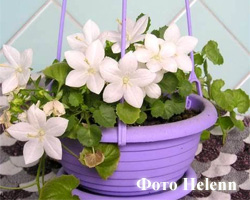
 Campanula equidistant
Bell family. Homeland - Mediterranean. About 500 species are common in nature. Suitable for growing in hanging baskets and planters.
Campanula isophylla is a perennial herbaceous plant about 15 cm tall, stalks creeping, leaves on long petioles, alternately arranged, heart-shaped, about 5 cm long. The surface of the sheet is light green, with a serrated edge. Panicle inflorescences, flowers light blue or white, bell-shaped, five-petalled, up to 3.5 cm in diameter. The fruit is a box.
Portenschlag bell Campanula portenschlagiana is a perennial plant native to the Dalmatian Mountains in Croatia. A low lush bush is about 10-12 cm tall, and reaches 50 cm in width. The flower corolla is deep purple or blue, funnel-shaped, 5-petal. The flowers are small, about 1.5-2 cm in diameter. Quite frost-resistant species (up to -32-34 ° C in winter).
Campanula: Care and Cultivation
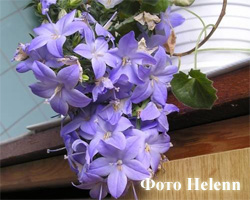 Campanula equidistant
Temperature: moderate, does not tolerate heat in summer above 25 ° C. In winter, cool content, about 12-14 ° C.
Lighting: bright diffused light, shading from the direct sun on the south window. If it is too dark, the plant is swollen, the shoots are stretched, and the distance between the leaves increases. It grows best on the east or northwest windowsill.
Watering: plentiful in spring - summer, the soil should be moist inside the pot, but dry out in the upper layers of the soil. In winter, the dormant period, watering is very, very rare at cool temperatures, or is replaced by spraying.
Fertilizer: from March to August, fed with fertilizer for indoor ornamental flowering plants, once every 2-3 weeks. The ratio of macronutrients is desirably equal to, for example, NPK 10-10-10, not bad if the fertilizer additionally contains minerals (boron, iron, magnesium, zinc).
Humidity: Loves daily spraying, can be put on a tray with wet gravel.
Transplant: Annually in the spring. Soil mixture: the 1 part of the turf, the 1 part of the leaf, the 1 part of the humus, the 1 part of the sand, if the soil is covered with salt coating on top, it is better to replace it with fresh earth. Be sure to do the lower drainage so as not to flood the plants.
Reproduction: by seeds, dividing the bush and cuttings in spring. Cuttings easily root in water. Special trimming of the campanule is not required, the thicker the bush, the more abundant the flowering.
Growing problems: Can be affected by rust, powdery mildew and leaf spotting. A tick is very harmful if it moves to a plant from roses or store plants. Attention: snails and slugs are eaten in the campanulu garden!