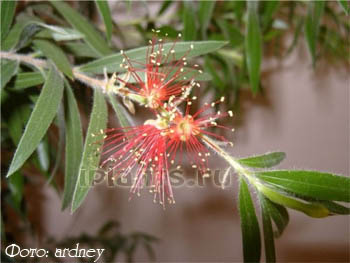
 Callistemon lemon
Myrtle family. The genus includes about 40 species of small evergreen trees or shrubs. Homeland - Australia and New Caledonia. Close relatives are Mirth, Metrosideros and Melaleuca.
Callistemon lemon-yellow Callistemon citrinus is an evergreen shrub, about 2-3 m high, the leaves are alternate, narrow, lanceolate, about 7 cm long, 7-8 mm wide, leathery, gray-green, if rubbed, the lemon aroma is felt (hence the name of the species). Inflorescences are apical, spike-shaped, about 10 cm long, appear in July. The flowers have very short petals and sepals, the corolla is five-lobed, and very long, numerous stamens, reaching 5 cm, saturated red with yellow anthers. A feature of the genus is the continuation of the peduncle with a vegetating shoot (shoot with leaves). In nature, in full lighting, the inflorescences of callistemon are very fluffy, the flower-bearing shoots themselves resemble ruffles in shape.
Callistemon linearis is a shrub up to 3 m high, narrow-lanceolate leaves, about 10 cm long and 3 mm wide. Inflorescences about 13-15 cm long.
Callistemon salignus is a branched tree, reaching 10 m tall, with narrowly elliptical leaves, on young shoots with a purple tint. Leaves 7-9 cm long, 7-14 mm wide, pointed at the end in shape resemble willow (hence the name of the species). Inflorescences about 5-7 cm long, stamens in the flowers are cream with yellow anthers.
Callistemon rod-shaped Callistemon viminalis is a branched tree reaching 8 m tall. Leaves are linear, gray-green, 3-7 cm long, 3-7 mm wide, inflorescences up to 10 cm long. Stamens purple-red, about 6 cm long, a feature of the species - stamens at the base fused into a ring.
Callistemon Care
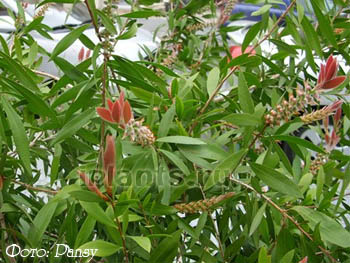 Callistemon oriole
Temperature: moderate, with room content in winter it is advisable to ensure a temperature not higher than 12 ° C, winter minimum + 5 ° C. In late spring, when the threat of frost passes, callistemon can be taken to the garden, to a sunny place protected from the wind.
Lighting: Full solar lighting. Preferably south or southwest window sill. If there is little light, for example, on the northern windows, callistemon does not bloom and shoots are noticeably extended. If you notice that the shoots are exposed from below, it is worth considering additional lighting with fluorescent lamps.
Watering: plentiful from spring to autumn, watered in winter so that only the top layer of the earth dries up. Like all myrtle callistemon, it does not tolerate overfilling and stagnation of water. Make large drainage holes at the bottom of the pot, and drain the water from the tray after watering.
Top dressing: from March to August they are fed with complex fertilizer for azaleas or heather. Apply fertilizer every three weeks, no more often. Callistemon reacts to fertilizer overfeeding by yellowing and dropping leaves, so it is better to underfeed than overfeed.
Air humidity: regular spraying or a tray with water, if cool wintering is not provided so that the plant does not suffer from dry air.
Transplant: Annually in the spring. The soil 2 part of the sod, 1 part of the peat land, 1 part of the humus, 1 part of the sand, 1 part of the pine bark. Callistemons do not tolerate calcareous soils - the pH is only slightly acidic. If a salt effusion (dry white or red plaque) appears on the surface of the earth, remove the top layer of the earth and replace it with a fresh one. It is worth more carefully preparing water for irrigation - filter and boil. The pot should not be too spacious, but only commensurate with the root system.
In the spring, at the beginning of growth, the calistemon can be cut off, forming a crown. Callistemon is also cut off after flowering, to give a more decorative look. The thing is that many find the appearance of seed boxes on the shoots unsightly - they look like burnt Bengal candles - "the ball is over, the candles have gone out," so they are cut off. Pruning, in turn, improves the bushiness of the plant, which subsequently leads to more abundant flowering .
Reproduction: semi-woody cuttings and seeds. Seeds are sown in plates in a mixture of peat and sand (in equal quantities) in the month of March, without sprinkling with earth. They moisten the ground well, cover it with glass or film. The ground in the area should be damp all the time and regularly ventilated. Dive into permanent pots when 2 pairs of real leaves develop at the seedlings.
Cuttings are cut 8-10 cm long, leaves are cut off from the lower half of the cuttings or 2/3 of the height from below. Rooting in moist vermiculite or in water, in a room greenhouse (or under a transparent cap). It is advisable to pre-treat the cuttings with a growth stimulant (for example, the drug Roenorenite, or Heteroauxin). Rooting usually occurs in 1.5-2 months.