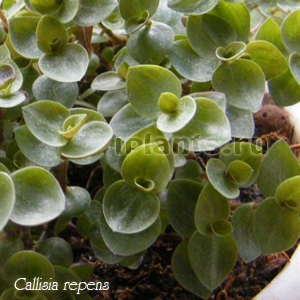
 Callisia creeping
Commelin family. Homeland - Central and South America. About 20 species are common in nature. Callisia is a close relative of tradescantia. Many of our grandmothers grow fragrant callisia at home as a medicinal plant for almost all diseases. Whether a tincture of callisia helps or not is up to you, but it is known that all types of callisia cleanse and moisturize the air in the house well.
- Callisia creeping Callisia repens is a perennial herbaceous plant about 10 cm tall, stalks creeping, creeping, densely leafy. The leaves are alternately arranged, with a tubular vagina (tightly covering the stem), heart-shaped, pointed at the end, about 10-15 mm long. The surface of the sheet is green, the reverse side is burgundy. It is used as a ground cover plant or ampelny.
- Callisia fragrant Callisia fragrans is a "golden mustache" known throughout the country, perhaps the most common medicinal plant on our windowsills. There are two types of long shoots. Some are shortened, growing vertically, with a dense rosette of juicy leaves (the leaves are sessile, alternately located, but the distance between them is minimal). Leaves are oblong up to 20 cm long, dark green, pointed at the end. Another type of shoot, rather resembles a strawberry mustache - shoots creep along the ground, but have rare leaves when they root elsewhere, grow back up and form a powerful rosette of leaves. Inflorescences are racemose with small white flowers, with a pleasant aroma.
- Callisia scaphoid variation graceful Callisia gentlei var. elegans is a perennial herbaceous plant about 30-40 cm tall, stalks creeping, leaves are alternately located, with a tubular vagina, ovoid, pointed at the end, about 7 cm long. The surface of the leaf is dark green with longitudinal silver stripes along the veins, the reverse side of the leaf is purple. The stems and leaves are covered with pubescence. In late summer and early autumn, it blooms with white nondescript flowers.
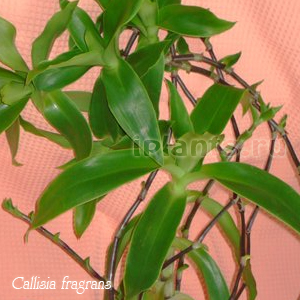 Callisia fragrant
Callisia care
Temperature: moderate, in summer optimally during the day about 26 ° С, at night 18-20 ° С. In winter, a cooler content at 116-18 ° C, at least 12 ° C, is desirable. In warmer conditions in winter, plants are strongly stretched, depleted, by spring they are very bad and you need to resume bushes from cuttings.
Lighting: bright diffused light, shading from the direct sun during the hot part of the day. If it is too dark, the plant is swollen, the shoots are stretched, and the distance between the leaves increases. In winter, callisia can stand on the southern windowsill, in spring and summer without shading only on the east or north-west.
Watering: plentiful from spring to autumn - the soil should be slightly moist all the time inside the pot, i.e. watered as the top layer of the earth dries. In winter, watering is moderate, rare, depending on the temperature, i.e. the soil should dry well in the upper part of the pot before watering again.
Top dressing: from March to August, callisia is fed with fertilizer for indoor ornamental and deciduous plants every two weeks, at a dose two times less than recommended.
Air humidity: the plant loves daily spraying, the optimal air humidity is 40-50%. The main thing is to protect batteries from directed hot air during the heating season.
Transplant: Annually in the spring. The soil is slightly acidic, a mixture: the 1 part of the turf, the 1 part of the leaf, the 1 part of the humus and the 1 part of the sand (or pine bark). Callisia grow quite quickly - shoots stretch out, bare in the lower part (primarily because there is little light or warm wintering). Therefore, the plant is rejuvenated - in the spring, apical cuttings are cut and rooted in water, several cuttings are planted in one pot.
Breeding: stem cuttings (theoretically at any time of the year), take root within a week or two. Cuttings just need to be put in a jar with clean water, change water every 2-3 days. You can plant cuttings in a pot when the roots grow about 4-5 cm. You can use soil from a store, for example, TerraVita or any universal soil.