Derbennikov family. Homeland - South America. In nature, there are about 200 species of blechnums.

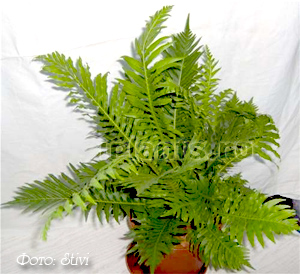
Humpback blechnum Blechnum gibbum - in nature, this is a large, palm-like plant with vai reaching 1.5 m in length. The stem of the fern is a modified rhizome, in old plants in room conditions it reaches a height of about 50 cm, covered with brown scales. Its wai are single-pinnately dissected about 50-60 cm long, light green. Sporangia on the underside of the leaf, closer to the edge of the segments.
At home, blehnum, of course, is smaller - old specimens occupy about 100 cm in width and the same height. But this fern is a real home ornament.
How to grow blehnum
Temperature: Blehnum - fern of warm rooms. In summer, it is kept at ordinary temperatures, optimally up to 28 ° C, in the heat of dry air at blechnum, wai can dry. In winter, it is desirable to lower the temperature to 18-20 ° C, at least 16 ° C. Be sure to protect the fern from the directed hot air of the heating batteries.
When airing, especially in winter, rearrange the plant away from the flow of cold air, including from the air conditioner.
Lighting: The place should be quite light, but with shading from direct sunlight - bright diffused light or light partial shade. Blechnum grows well on the north and north-west window, well on the east and south-east. You can put a pot near the south window under the shade of a tulle curtain or blinds. It will be hot on the western windowsill in summer. But in winter, from about October to the end of January, direct sun will not harm ferns at all.
Watering: Only with warm settled water that does not contain lime. They water blehnum in spring and summer abundantly, wetting well with an earthen lump, but only after the upper layer of the earth dries up. In winter, watering is moderate, the soil should not dry out completely, to a dusty state.
Fertilizer: In summer, liquid fertilizer for indoor deciduous plants every two weeks. Blechnum is very sensitive to excess fertilizer, so the dose should be taken 2 times less than recommended by the manufacturer. Never fertilize after a transplant for at least 1.5 months.
Humidity: Like many ferns, blechnum likes moist air, but spraying can ruin leaves. Therefore, pots with plants are placed on pallets with wet expanded clay. Batteries are hung with a damp cloth in winter.
Transplant: Transplants are carried out in the spring, when the roots will fill the entire pot. The soil should have a slightly acidic reaction. The soil is 2 part of the sheet land, the 1 part of the peat, the 1 part of the humus land and the 1 part of the sand. It can be added to the substrate of chopped pine bark. Good drainage at the bottom of the pot and drainage holes are mandatory.
Reproduction: Predominantly by dividing the bush or spores forming on the back of the leaves. When breeding by dividing the bush, during transplantation you need to cut 2-3 leaves with a small part of the rhizomes with a sharp knife from the edge of the bush. Place the plot in a pot, about 2 cm larger in size than the root lump. Cover with earth and water. The fern grows slowly after transplantation - at first the root system gains strength, new roots grow. Noticeable growth can only be a month after transplantation. Do not replant or share bushes of blechnum and other ferns during the hot summer.